

Blog

Incident Documentation Survey: The Property Manager Gap

Feature Webinar: Ask the Expert: Multi-Family Must-Knows About Pool Safety
‍Thursday, April 3rd, 12PM ET / 9:00 AM PST
Register Here
6 Mins

The Short answer:

In an October 2026 poll, 71% of property management professionals rated their incident documentation Good or Excellent. 

But only 36% were very confident it would pass a legal audit. That difference is the documentation gap, and it's where liability claims are won or lost.

We asked two experts what it means: attorney Melinda McBeth, J.D., Counsel at Offit Kurman, and Megan Davidson, ARM, CRIS, Senior Vice President at Alliant Insurance Services.

‍

Key findings at a glance

FindingResult
Rate their documentation Good or Excellent71%
Very confident it would pass a legal audit36%
Rate it Good or Excellent but aren't very confident in an audit47%
Couldn't retrieve needed footage 2 to 3 times last year38% (69% of those who handle retrieval)
Have a specific video retrieval frustration65%
Top priority: real-time detection and response42%
Top priority: documenting consistent enforcement0%
Source: Cloudastructure live poll of property management professionals, October 2026. Percentages are of those who answered each question.

‍

Finding 1: Property managers are confident in their documentation. Until they’re going to court.

Would your documentation pass a legal audit tomorrow?

  • Very confident: 36%
  • Somewhat confident: 32%
  • I don't know: 20%
  • Not very confident: 12%

Even among those who rated their documentation highly, almost half weren't very confident. Good records aren't the same as defensible ones.

"You must, must, must make sure that all of your documentation is in a row in the file, that you have incident reports, that you have objective evidence," says attorney Melinda McBeth.

‍

Finding 2: The video is missing when you need it

Video is the most objective part of an incident record. "If you have video surveillance showing the conduct and the behavior, that's like the smoking gun," McBeth says. Written witness statements, by contrast, are often inadmissible hearsay.

Yet it's often missing. 38% couldn't retrieve footage they needed two or three times last year. For those who handle retrieval, it's 69%.

Another 45% weren't sure. If no one knows whether the footage exists, no one finds out until a claim arrives.

Top frustrations when retrieving video:

  • Poor video quality or coverage: 38%
  • Searching multiple feeds: 19%
  • Only fast forward and delete: 8%

Even 41% of those who rated their documentation highly couldn't get footage they needed.

‍

Finding 3: No one is documenting consistency

What would most improve liability management?

  • Real-time detection and response: 42%
  • Faster video retrieval: 29%
  • A more complete incident history: 25%
  • Easier evidence sharing: 4%
  • Documenting consistent policy enforcement: 0%

That 0% stands out. Most teams believe they already enforce rules consistently, so proving it doesn't feel urgent. But documented consistency is the main defense against retaliation claims, which more than doubled in 2024, according to the National Fair Housing Alliance's 2025 Fair Housing Trends Report.

"Consistency is still your best defense to any retaliation claim," McBeth says. "Objective evidence like surveillance footage is the best thing that you can have to prove this."

‍

Why it costs more than it looks

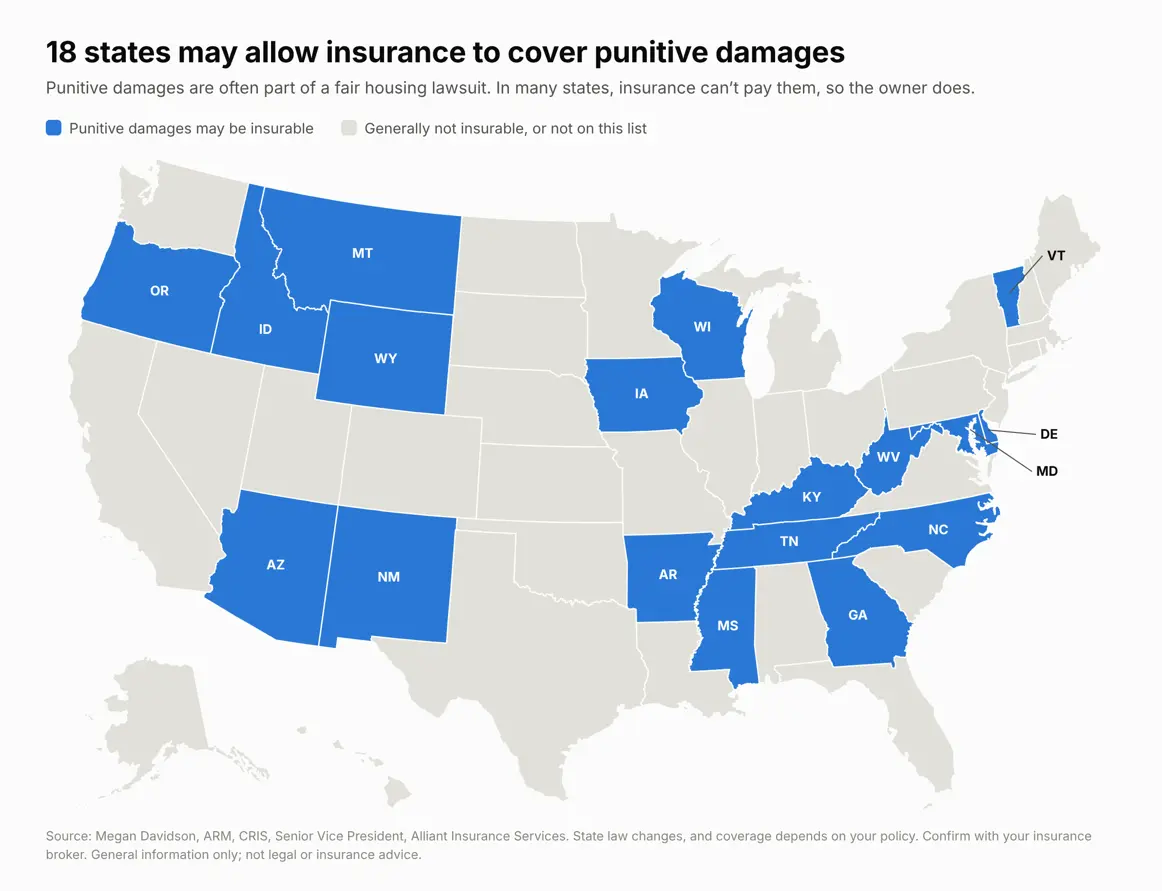
When documentation fails, the owner often pays. A discrimination lawsuit "is not covered under general liability," says Megan Davidson. It takes specific coverage, such as Tenant Discrimination liability. And punitive damages are insurable in only 18 states.
‍

Davidson has seen the flip side. Hallway cameras caught a resident dispute that turned violent, and the resident who started it filed the biggest complaint. "Having that visual documentation rather than after the fact of somebody writing up a report based on their perspective was really, really impactful," she says.

‍

How to close the documentation gap

Four steps close most of the gap:

  1. Document conduct, not status. Record what happened and what you did. Skip opinions.
  2. Make video findable. Save key clips by resident, unit or issue, and keep them past 30 days.
  3. Catch incidents as they happen. AI detection and live remote guarding create a timestamped record as it happens.
  4. Prove consistency. Show the same rule applied the same way to everyone. Assume every email could be read by a judge.

Cloudastructure supports each step with AI video surveillance, live remote guarding, rapid search and playlists that keep incident video for up to a year.

‍

The bottom line

The sample is small, but the pattern isn't new. In our liability webinars, teams rate their documentation highly until they need it to defend a claim. Our other surveys show the same gap:

This isn't about blame. Managers change, and you may not trust the files you inherited. Claims also move slowly. "By the time a case goes to court, witnesses have moved away, employees have left and memories fade," McBeth says. Objective video doesn't fade.

‍

The Risk Ahead: a year of data no one has seen

All year, we've asked property managers hard questions about liability, security, insurance and documentation. On Friday, November 20, at 12 PM ET, we're releasing the full findings for the first time in The Risk Ahead: 2027 Security, Liability & Loss Prevention.

You'll get a year of data, plus insight from Offit Kurman and Alliant, interpreted by Melinda McBeth and Megan Davidson.

The stakes are climbing. Nuclear verdicts ($10 million or more) against companies rose 40.7% in 2025, according to Marathon Strategies.

If you lead risk, operations or a portfolio, see the gap before a claim exposes it. Your legal team won't want you to miss this one.

In 60 minutes, you'll learn:

  • What's driving insurance costs and claims
  • Where owners are most exposed to litigation
  • Why teams feel prepared when evidence is missing
  • How proactive security cuts losses
  • A practical 2027 risk playbook to protect NOI

It's free, and every registrant gets the recording.

Register free for The Risk Ahead, and bring your boss.

‍

Frequently Asked Questions

What is the documentation gap in property management?

It's the difference between how good property teams believe their incident records are and how confident they are those records would hold up legally. In our October 2026 poll, 71% rated their documentation Good or Excellent, but only 36% were very confident it would pass a legal audit.

Why does incident documentation matter for fair housing claims?

Fair housing defenses depend on showing that decisions were based on documented conduct and applied consistently. Without a clear record, a property can't show it would have taken the same action against any resident.

How often do property managers fail to retrieve needed video footage?

In our poll, 38% of respondents, and 69% of those who handle retrieval, said they couldn't retrieve footage they needed two or three times in the past 12 months.

Does general liability insurance cover fair housing lawsuits?

Generally no. General Liability covers bodily injury and property damage. Fair housing claims usually require specific coverage, such as Tenant Discrimination or Management Professional Liability that extends to Fair Housing Act claims. Talk to your broker about your policy.

General information only. Not legal or insurance advice.

‍

Sources

‍

‍

Experience why businesses choose Cloudastructure for video security and management.

Offices across the globe.

AUD

NYC

CHN

EU

Webinar: The Risk Ahead: 2027 Security, Liability & Loss Prevention
Register Now
Upcoming Webinar: Can AI Stop Cargo Theft? What Works, What Doesn't & Where AI Fits Register Now
Upcoming Webinar: Graying Residents — Seniors, Safety & Liability in Property Management Register Now
End of Year offer
Protect Now, Pay in 2026
Stay ahead of crime this holiday season with Cloudastructure’s AI Surveillance, and defer all payments until 2026.
Claim Offer Now
Shopping for AI Surveillance?
Not all of it is created equal. Grab our free cheat sheet with the 6 questions to ask every provider, plus what a good answer looks like.
Get the Free Cheat Sheet