


Blog

.webp)
We named five capabilities — real-time alerts, rapid video search, facial recognition where legally permitted, license plate recognition, and cloud retention that isn't overwritten. Sixty-two percent refused to pick just one.
Poll insights from our August 2026 webinar, Domestic Violence, Fair Housing & Property Management Risk, with Melinda McBeth, Counsel at Offit Kurman; Megan Davidson, Senior Vice President at Alliant Insurance Services; and Peter Roehl, Director of Sales at Cloudastructure.
Published August 19, 2026 · Cloudastructure
Domestic violence is one of the few situations in property management where doing the wrong thing quickly is far more dangerous than doing the right thing slowly. As our panel put it: you don't get sued for the incident, you get sued for what you did next. In the cases landlords lost, the harm was retaliation against the victim in the form of an eviction or a fine — not a failure to intervene.
During the session we polled the 45 property management professionals on the line about how these situations actually play out at their communities. Not every attendee answered every question, so the figures below are percentages of those who responded to each one. The answers were more revealing than we expected — not because of any single number, but because of the gap between what teams say they encounter and what they say they'd need.
Here's what stood out.
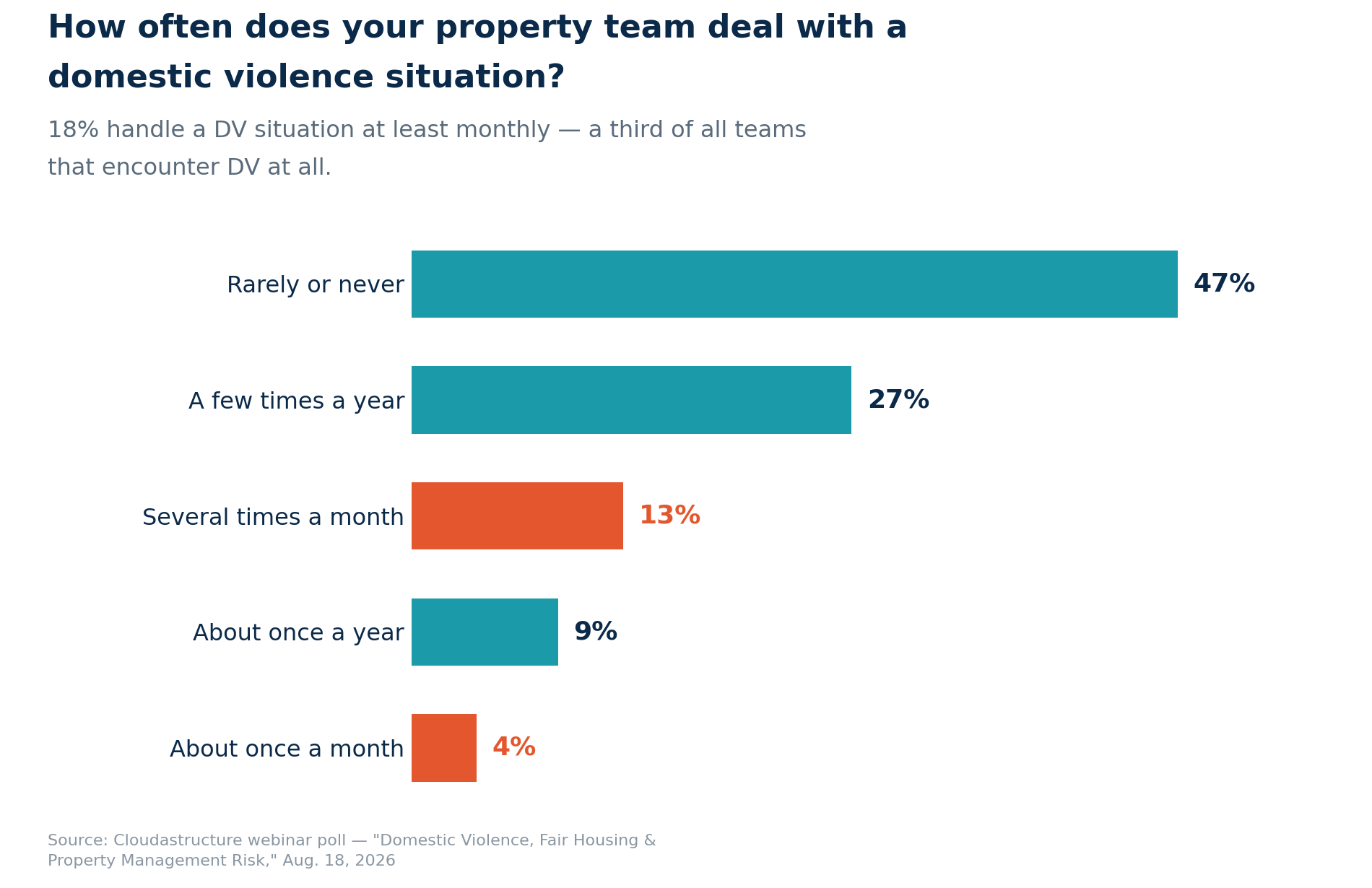
Start with the number nobody expects. Eighteen percent of respondents said their team deals with a domestic violence situation at least monthly — and 13% said several times a month.
Put another way: 24 of the 45 respondents encounter DV situations at their communities with any regularity at all. Of those 24, a third handle one at least once a month. For that group this isn't an edge case to be covered by a policy nobody has read. It's a standing operational load, running alongside leasing, maintenance, and renewals, with legal exposure attached to every judgment call.
That's the finding to sit with, because it changes who this topic is for. A property that sees one DV situation every few years can treat protocol as a document. A property seeing one a month is running that protocol constantly — which means every gap in it gets exercised, repeatedly, by different staff members on different shifts.
Now the counterweight. Forty-seven percent said their team rarely or never deals with these situations. On its face that reads like reassurance. Read against the rest of the poll, it reads more like a definitional problem.
Our panel drew a line most policies don't: legally, a DV case begins when a resident tells you. Practically, it begins the moment your staff knows. A camera captures an altercation and no report is filed. Neighbors report a frightening argument and nothing is confirmed. In both cases the property now knows something — and in both cases most teams file it under "noise complaint" rather than "DV situation."
So the 47% may be measuring formal reports rather than actual incidents. Which suggests the monthly number isn't the ceiling. It's the floor — the teams that have gotten good enough at recognizing these situations to count them.
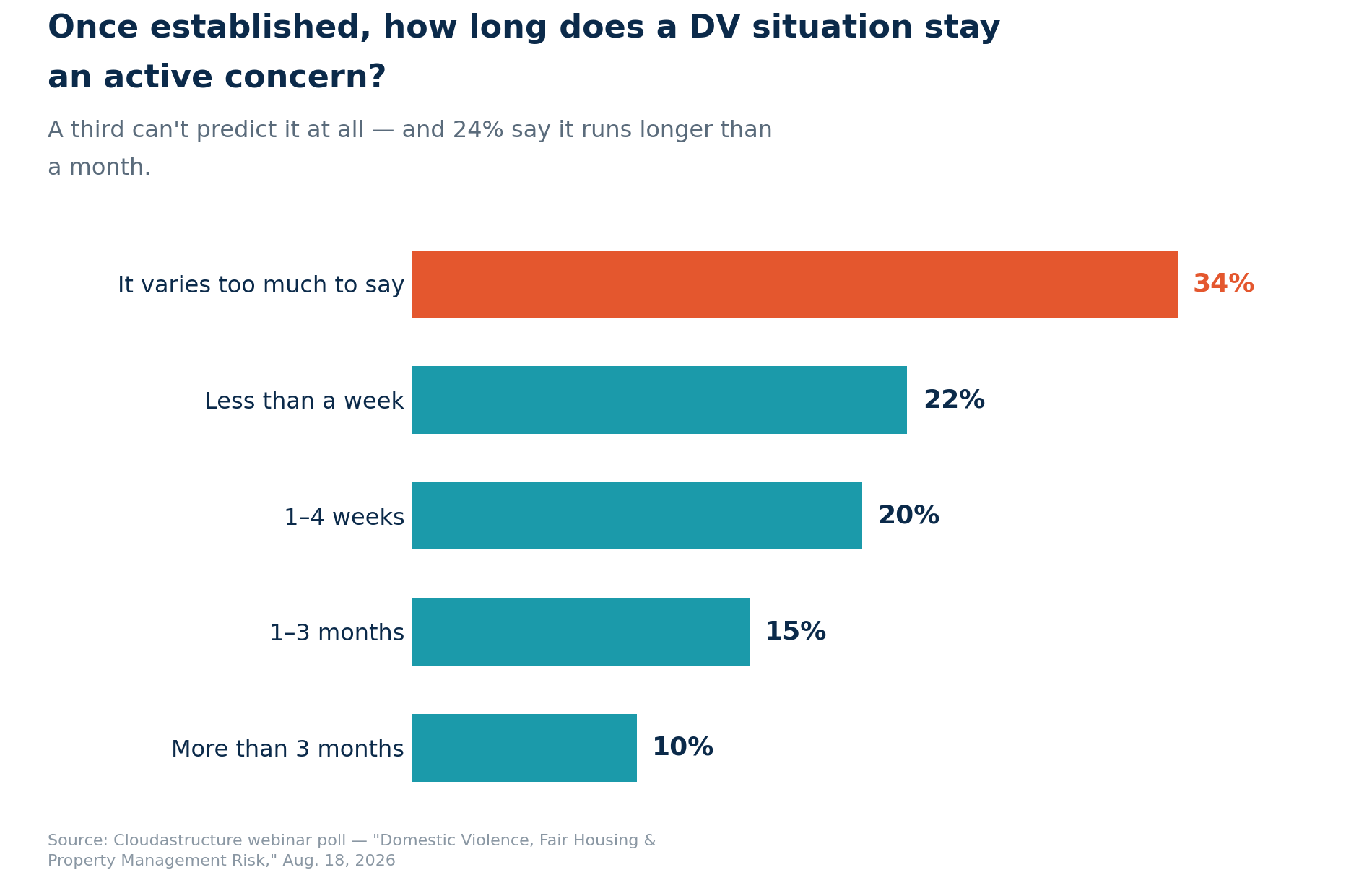
The most common answer to how long a situation stays active — 34% — was "it varies too much to say." Another 24% said longer than a month.
This is the finding with the most direct operational consequence, and it's about retention. The duty to preserve footage attaches when litigation becomes reasonably foreseeable — a police response, an injury, a protective order, a demand letter — not when a suit is filed. If a situation can stay live for three months and you can't predict which ones will, then a local recorder with a fixed overwrite cycle is a race someone has to remember to run. Every time.
Unpredictable duration plus a fixed overwrite window on your surveillance is how relevant footage disappears. Once it does, the property isn't just missing evidence; it's facing a spoliation argument and a possible adverse-inference instruction.
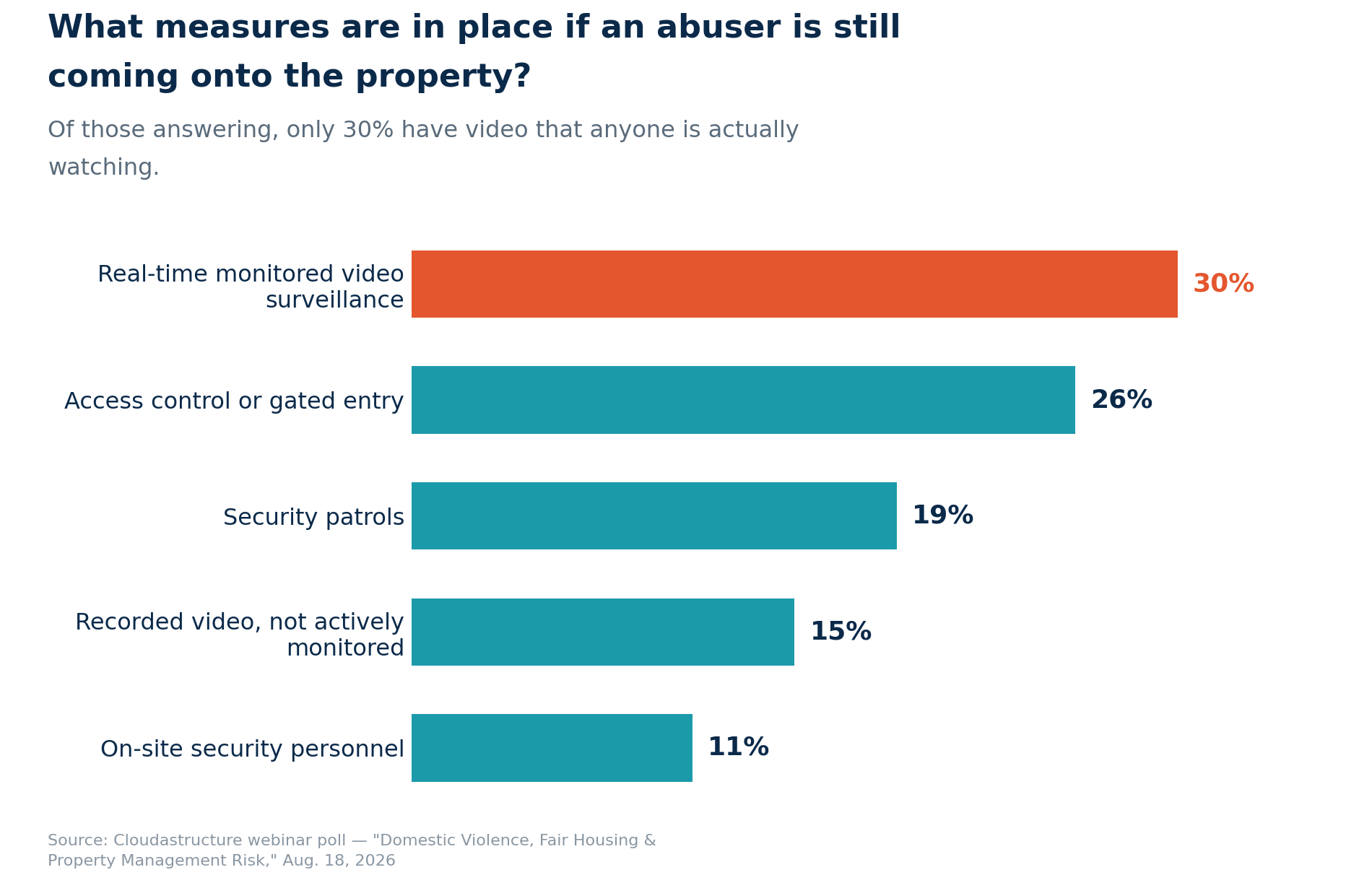
We asked what's in place when a known or alleged abuser is still coming onto the property. Thirty percent cited real-time monitored video. The remaining 70% named measures that are either passive or intermittent: recorded video nobody watches, gated entry, patrols, on-site personnel.
Each of these has real value, and our panel made the case for access control specifically: camera footage paired with access-control logs gives police something concrete to act on when enforcing a no-trespass order or a protective order. But it's worth noting what recorded-but-unmonitored video can and can't do. It can tell you what happened yesterday — useful for the file, and no help in the moment the situation is unfolding.
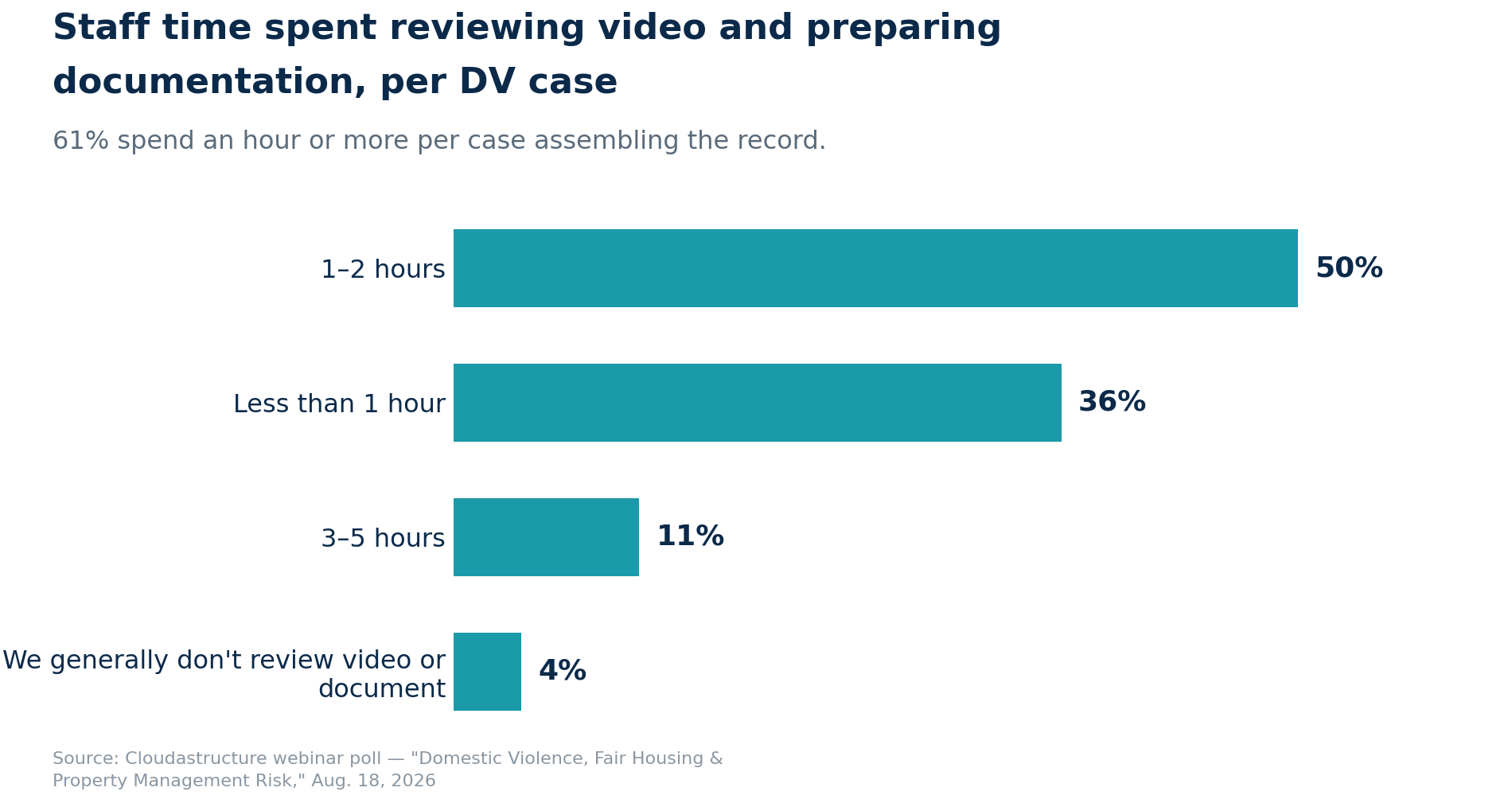
Sixty-one percent spend an hour or more per case reviewing video and preparing incident documentation. Half spend one to two hours; 11% spend three to five.
That time is not optional. Our panel was emphatic that the file is the defense: what was reported and when, what you asked for and what came back, who was notified and who had access, what you offered and what the resident chose, when you acted and why on that day. A boring, documented process beats a sympathetic story.
But there's a difference between the time spent making decisions and the time spent scrubbing through footage to find the four minutes that matter. The first is judgment. The second is search — and search is a solved problem for anyone who has the right tooling.
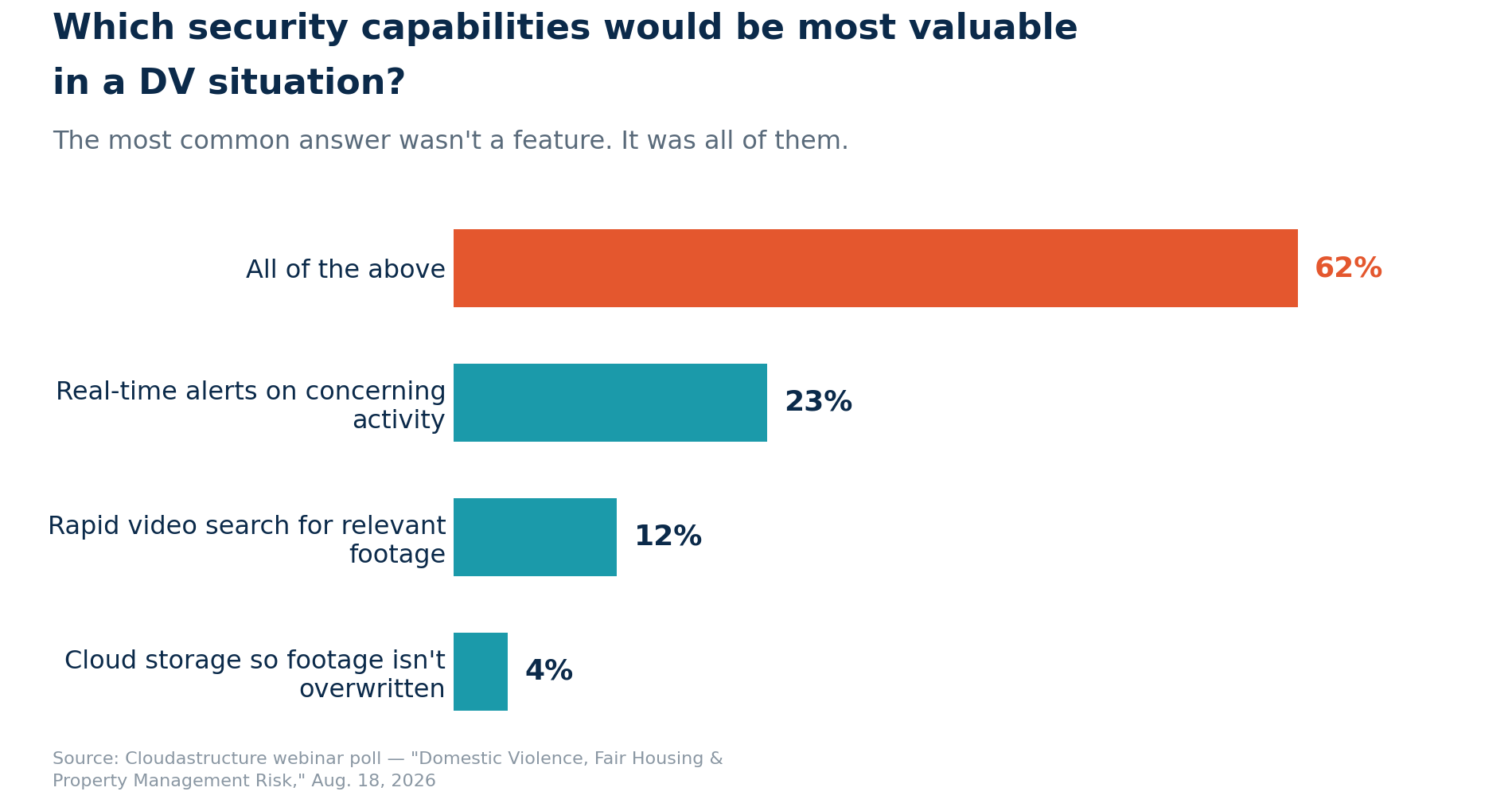
We named five capabilities and asked which would be most valuable in a domestic violence situation: real-time alerts on concerning activity, rapid video search, facial recognition (where legally permitted), license plate recognition, or cloud-based storage that isn't overwritten. The last option was all of the above.
Sixty-two percent chose all of the above. And all of those features are available on Cloudastructure's AI security and remote guarding platform.
Line the findings up and a consistent picture emerges. These teams are managing situations of unpredictable duration, using measures built for a different threat model, spending real staff hours reconstructing what happened, and — when asked what would help — describing a complete capability stack rather than a single feature.
The case for cameras someone is actually watching
Megan Davidson made the most direct plea of the session, and it was about monitored video specifically. A remote guard watching a live feed can intervene in a developing situation — a voice-down, a verbal warning, a presence announced before anyone lays hands on anyone. A great many altercations disperse at exactly that point.
She was careful about the limits of that claim, and we will be too: it will not stop a determined domestic abuser. What it does do is compress the two things that actually matter once an incident is underway. It identifies the perpetrator quickly — the aggressor-verification step our panel called the single control that prevents the worst outcome, which is penalizing the person who was assaulted. And it gets law enforcement on scene faster, with someone able to tell them what is happening right now rather than what a neighbor thinks she heard.
Set that against the poll. Only 30% of those answering have video anyone is watching. The other 70% have footage that can describe yesterday and a perimeter built to exclude strangers — in a situation where the person of concern is frequently admitted by a resident or already lives there.
Why 100% incident reporting is a legal argument, not a feature
Here is the point both the attorney and the insurance executive kept returning to, from different directions.
Property management runs roughly 35% annual turnover, Alliant Insurance SVP Megan Davidson noted. Residents move too. So consider the arithmetic of a claim filed eighteen months after an incident: the leasing agent who took the report has left, the maintenance tech who saw the hallway argument has left, the neighbor who called it in has moved out, and the on-site manager is reconstructing a decision she wasn't there for. What's left is the file. If the record is thin or inconsistent, the property is defending itself with somebody's memory of a job they no longer hold.
Inconsistency is the exposure — and it rarely comes from bad intent. It comes from turnover, competing priorities, and a busy Tuesday when nobody wrote it up.
This is where consistency stops being a virtue and becomes the whole ballgame. Our panel named inconsistency as the exposure — staff checked on this unit but not that one, with no documented reason why. That's the raw material of a standard discrimination claim.
Live monitoring with 100% incident reporting solves that structurally rather than through diligence. Every incident in covered common space produces the same record, in the same place, in the same format — without depending on which employee was on shift or whether anyone remembered. Two years later that's a far better answer to "why did you treat these two households differently?" than a leasing agent's recollection, because there is no recollection involved.
The gap the poll actually exposed
Which brings us back to the 62%. That answer is worth sitting with, because it's the gap we hear most often in conversations after these webinars. Property teams know what they need. What they often don't know is that it exists as an integrated system rather than five separate purchases.
Real-time alerting, cloud retention that holds footage a year or more with nothing to overwrite, and search that surfaces the relevant clip in seconds are the same platform — the one Cloudastructure built. Add license plate recognition, facial recognition where legally permitted, live remote guarding with 100% incident reporting, and one-click preservation to a retained playlist, and the "all of the above" answer stops being a wish list and becomes a configuration.
A closing note on guardrails, because our panel was clear about them: common areas only, audio off, signage posted, and never market a community as "secure" — that language can be read as assuming a duty you then have to perform. Get counsel's sign-off on your footage release and retention policies; state rules vary meaningfully.
Go check whether your property has the four things most properties don't. None of them requires a purchase order:
Then ask the harder question: if the person who handled your last DV situation left the company tomorrow, what would be left to defend it with? At 35% turnover, that isn't hypothetical.
The poll described a property management workforce carrying real risk with tools built for a different problem — passive footage, perimeter gates, and documentation assembled by hand under time pressure, by people who may not be there when the claim arrives.
Your staff needs 21st-century surveillance for risk management. Your residents need it for safety. Those aren't competing priorities — they're the same system.
Real-time alerts, live remote guarding with 100% incident reporting, rapid search, license plate and facial recognition, and cloud retention that holds footage a year or more. The capability stack 62% of your peers said they needed, on one platform.
The capabilities in this poll (real time alerts, monitored video, rapid search, and retention that doesn't get overwritten) are already built into Cloudastructure's platform. Schedule a demo to see it running on cameras like yours, or visit cloudastructure.com to explore the full platform.
.webp)
Melinda McBeth
Counsel, Offit Kurman
Melinda McBeth is Counsel at Offit Kurman, where she represents landlords and property management companies in residential and commercial real estate matters. Her practice includes Fair Housing disputes, administrative agency complaints, lease and contract issues, and civil litigation. A seasoned trial attorney with more than a decade of experience in Maryland courts, Melinda previously served as a public defender and criminal attorney, representing clients in juvenile, misdemeanor and felony matters. Her experience on both sides of the legal system gives her a practical perspective on how property managers can navigate resident safety concerns while balancing Fair Housing obligations, resident rights and liability.
Megan Davidson
Senior Vice President, Alliant Insurance Services
Megan Davidson is a Senior Vice President at Alliant Insurance Services, where she is part of a team that provides insurance solutions for millions of housing units nationwide, as well as commercial real estate, construction and other complex risks. With deep experience in multifamily and affordable housing, Megan works closely with property owners and operators to navigate liability exposures, coverage considerations and risk-management strategies. She also serves on the Board of Directors of the NAHMA Educational Foundation, which supports residents of federally subsidized housing and promotes stronger, more vibrant affordable housing communities across the country.
Poll conducted live during the August 18, 2026 webinar "Domestic Violence, Fair Housing & Property Management Risk." 45 attendees participated; response counts varied by question, and percentages reflect those who answered each question. Retaliation complaint figures cited during the session are drawn from National Fair Housing Alliance Fair Housing Trends Reports; the April 2026 VAWA housing settlement was a Department of Justice enforcement action. The industry turnover figure was cited by Megan Davidson during the session.
Educational content for property management professionals. Not legal advice. Review all guidance with counsel.





.svg)
.svg)

.webp)

.webp)