


Blog

.webp)
During our webinar Little Residents, Big Liability we surveyed property management and multifamily housing professionals who deal with child safety and Fair Housing risk day to day. The results point to a gap that's common across the industry: most operators don't yet have a reliable way to know when a child-safety incident happens on their property, and even fewer are confident their evidence would hold up if a claim followed.
Here's what the data shows.
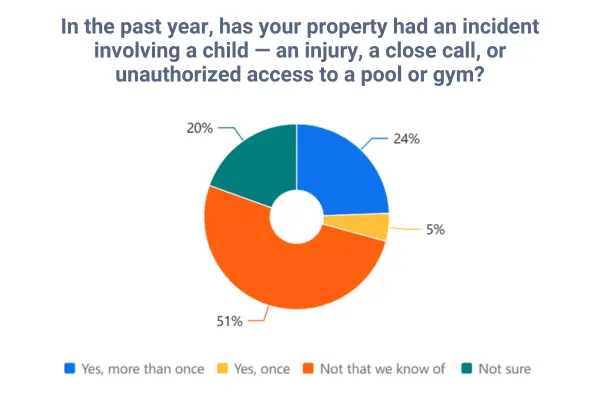
We asked: In the past year, has your property had an incident involving a child — an injury, a close call, or unauthorized access to a pool or gym?
That's 29% with a confirmed incident in the last twelve months alone — real kids who ended up somewhere they shouldn't have been. The other 71% aren't necessarily in the clear: some of those incidents likely happened too, they just went uncaught.
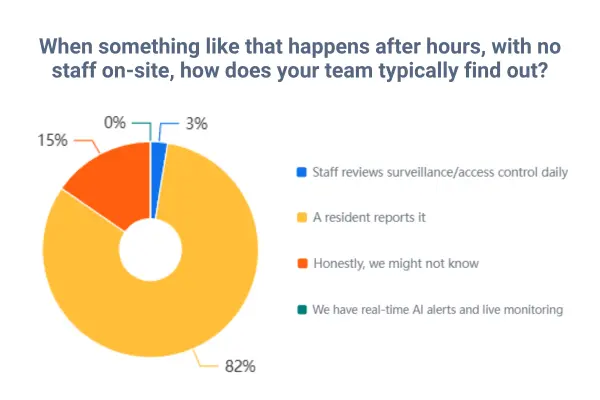
The follow-up question got at why that uncertainty exists: When something like that happens after hours, with no staff on-site, how does your team typically find out?
Not a single respondent had a system actively watching for these incidents as they happen. Across the board, the industry's early-warning system is word of mouth from residents — which only works if someone happens to see it, and happens to say something.
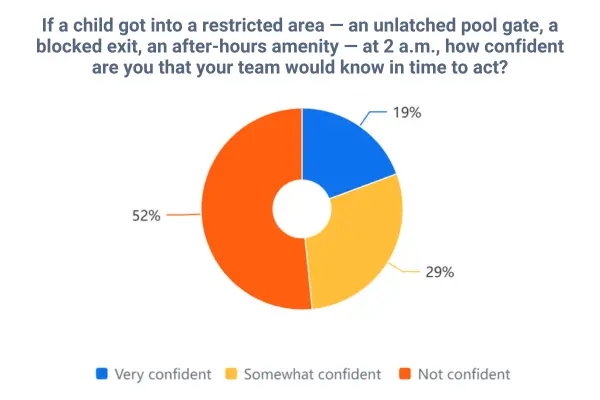
We pushed the scenario further: If a child got into a restricted area — an unlatched gate, a blocked exit, an after-hours amenity — at 2 a.m., how confident are you that your team would know in time to act?
More than half of respondents said they don't believe they'd catch a middle-of-the-night incident in time to prevent it from getting worse. Picture what that actually looks like: a child slipping through an unlatched pool gate at 2 a.m., with no staff on-site and no one watching, and no way to know until someone happens to notice the next morning.
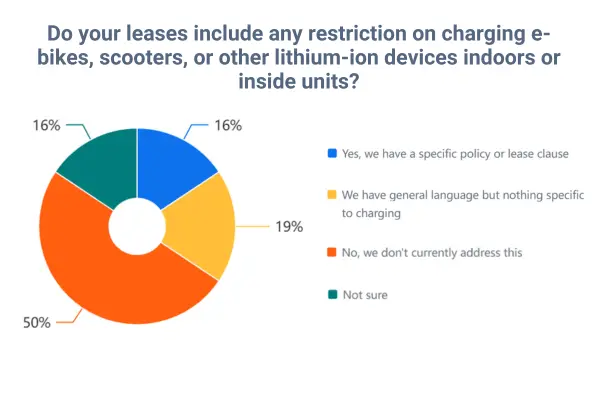
Kids’ e-bikes, hoverboards, and scooters are one of the newest fire hazards in multifamily housing. We asked: Do your leases include any restriction on charging e-bikes, scooters, or other lithium-ion devices indoors or inside units?
Half of properties surveyed have no lease protection at all against a hazard that insurers are increasingly scrutinizing — many renters' policies carry a "motorized vehicle" exclusion that can apply to e-bikes, and claims involving lithium-ion fires are being evaluated closely for negligence before coverage is confirmed either way.
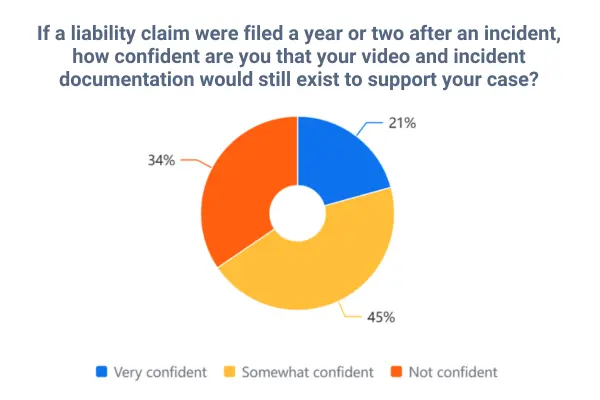
Only about 1 in 5 respondents said they'd be fully confident their evidence would still be there when they actually needed it — potentially years after the fact, and often right as a claim is being valued.
Liability claims involving children don't always surface right away. So we asked: If a liability claim were filed a year or two after an incident, how confident are you that your video and incident documentation would still exist to support your case?
Across every question, the pattern holds: most multifamily operators suspect they have a gap, and most don't yet have a system in place that closes it. That gap isn't a reflection on any individual team — for most of this industry's history, staff presence and resident reports weren't a choice, they were the only option available. That's no longer true. Continuous, automated monitoring exists now, and properties with children on-site may want to make the leap sooner rather than later — because until they do, this isn't really about paperwork or policy. It's about how long a kid could be in danger before anyone even knows.
Watch the full on-demand webinar or Learn more about Cloudastructure.





.svg)
.svg)

.webp)

