


Blog

Advice from attorney Melinda McBeth (Offit Kurman) and Megan Davidson, senior vice president at Alliant Insurance
.png)
Melinda McBeth, J.D. — Counsel, Offit Kurman. Melinda represents landlords and property managers across Maryland in fair housing disputes, leasing issues, and real estate litigation. A former criminal defense attorney with over a decade of trial experience, she also hosts her own webinar series on multifamily housing law. Offit Kurman is one of the fastest-growing full-service civil law firms in the U.S., with nearly 300 attorneys across 19 offices in 12 states and the District of Columbia.
.webp)
Megan Davidson, ARM — Senior Vice President, Alliant Insurance. Megan has spent roughly 30 years in insurance, with about 25 of those years focused on multifamily and affordable housing risk, and is licensed in all 50 states. Alliant Insurance is one of the top five insurance brokers in the nation, with a specialty multifamily practice that protects more than 3.5 million multifamily units annually.
Kids on a multifamily property create some of the biggest liability exposure a landlord will ever face — and some of the trickiest legal balancing acts. A child's brain isn't wired to recognize danger the way an adult's is, which means the pool, the parking garage, and even a half-finished renovation can look like an invitation to play rather than a hazard to avoid. At the same time, property managers have to navigate fair housing laws for apartments, which strictly limit how landlords can treat families with children.
Attorney Melinda McBeth of Offit Kurman and Megan Davidson, senior vice president at Alliant Insurance, have spent years advising multifamily owners on child safety in multifamily housing. Here's where they say child safety and legal liability collide across a property — and what owners and managers can do about it.
Before getting into specific hazards, McBeth laid out the ground rules. The Fair Housing Act prohibits landlords from discriminating against protected classes, which traditionally include race, familial status, disability, and national origin (some states, like Maryland, also protect source of income). For property managers, the familial status protection is the one that trips people up most often around child safety.
Landlords cannot segregate families with children to certain floors or buildings, steer them toward or away from specific units, or impose rules — like curfews or supervision requirements — that apply only to households with kids. "You can't encourage people who have families to maybe live in one part of your property... [that's] steering," McBeth explained. Violations can also include refusing to rent to anyone who is pregnant or who may have a child join the household after signing the lease.
The workaround, according to McBeth, is to write rules around behavior, not people. Rather than "all children must be accompanied by a parent," say "no unaccompanied minors." Rather than an age-based curfew, set quiet hours that apply to every resident. "That way you can say we're not singling out children specifically," she said. "We're just saying this is something that no one can do."
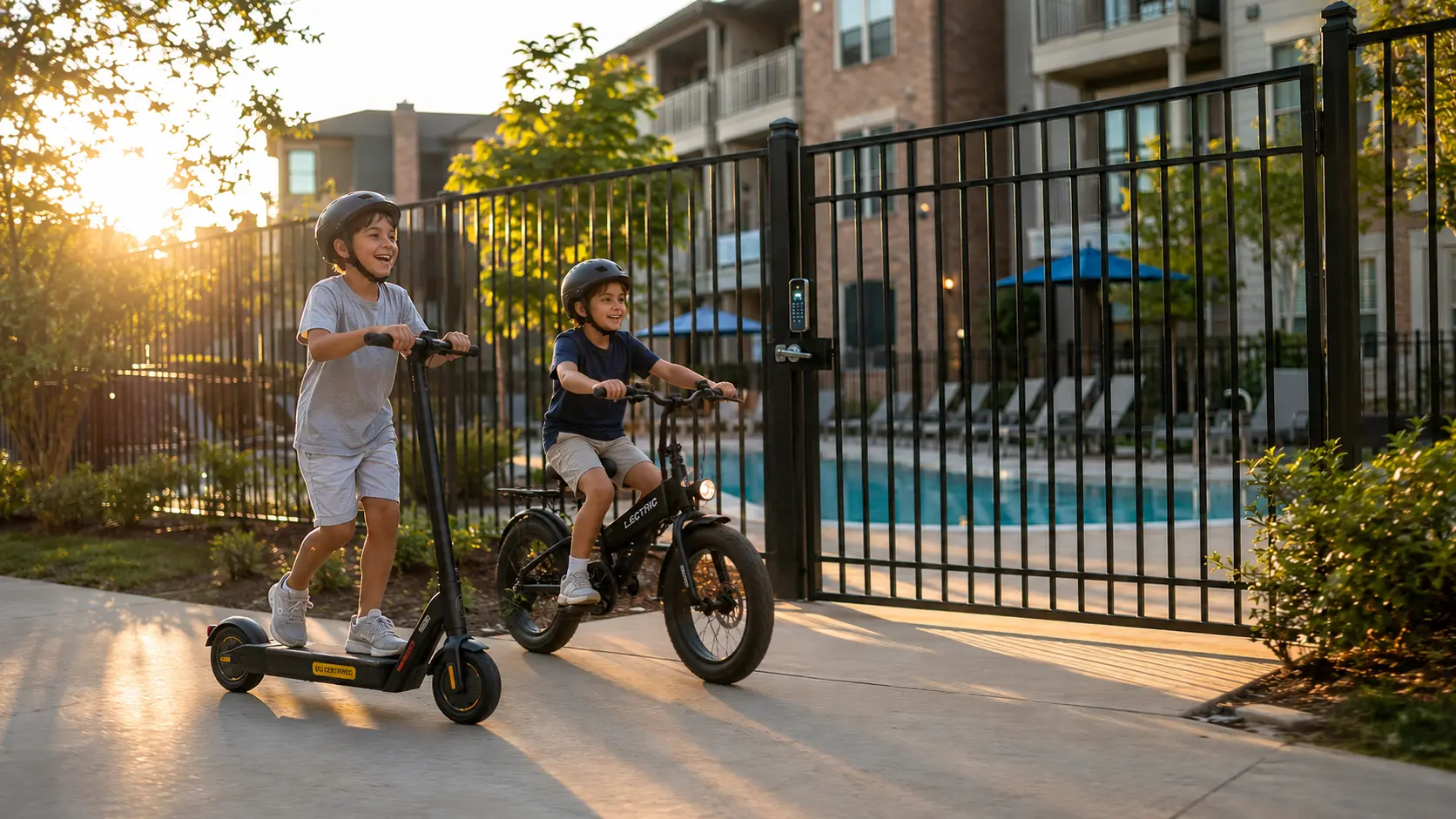
E-bikes, e-scooters, and hoverboards are a growing fire risk in multifamily housing. McBeth pointed to a case in Pennsylvania where a hoverboard caught fire and killed two girls, ages 10 and 15. Target and the manufacturer, Jetson Electric Bikes, ultimately settled the resulting lawsuit for $38.5 million.
Davidson explained how insurance treats these incidents when a property has no charging policy in place: "It's really an unintentional issue... it's a fortuitous thing. An insurance company would pay the loss," she said, and then typically subrogate — seek reimbursement — against the renter or the manufacturer. Renters insurance often excludes motorized vehicles, which is one more reason for landlords to have their own policy in writing.
Can landlords ban e-bikes and charging outright? Generally yes, McBeth said, since owning an e-bike isn't a protected activity. The complication arises when a resident's mobility device intersects with a disability, which does trigger fair housing protections and may require a reasonable accommodation. Davidson's recommended baseline: require any e-bike, scooter, or hoverboard allowed on the property to be UL certified, which reduces both fire risk and electrical load. Some jurisdictions require charging to happen outdoors, but Davidson noted that outdoor charging stations carry their own fire risk — enough that some insurers won't cover buildings with them at all, which is worth confirming with your broker before construction.
Pools sit at the intersection of premises liability, fair housing, and the ADA — and McBeth was candid that there's rarely a one-size-fits-all answer. The recurring tension: a pool gate needs to stay accessible to residents with disabilities, but an unlocked or propped-open gate is a genuine threat to child safety, since an unfenced pool is exactly the kind of easily accessible hazard that draws kids in without them understanding the danger.
Her suggested approach is to get creative rather than choose one group over the other — an access key card, an attendant, or a specialized latch that an adult can operate but a child cannot. Landlords can generally defend safety-driven policies against fair housing claims as long as there's a legitimate, non-discriminatory business reason behind them.
On the insurance side, Davidson pointed to a case where a Texas court handed down an $18 million verdict after management knew a pool gate had been left unlatched. Her advice: a written protocol for checking gates is only useful if it's followed every single time. "Don't have a policy that you don't follow all the time," she said — an unenforced policy can be worse than no policy, since it signals the landlord knew about the risk and didn't act on it.
Parking areas create fast-moving, low-visibility situations, especially with kids on bikes or scooters. McBeth recommended posted signage reading "no unaccompanied minors" in areas like pool decks, and behavior-based rules like "no playing" or "no reckless driving" in garages, since those apply to everyone regardless of age and hold up better against fair housing scrutiny. She also pointed to physical fixes that improve visibility without singling anyone out: white paint in garages to open up sight lines, and convex mirrors at blind corners.
Davidson added her own practical mitigation steps: enforce posted speed limits and prohibit sidewalk riding, both of which are common contributors to parking-area accidents. None of it eliminates every accident, but it demonstrates that the landlord took reasonable steps — which matters enormously if a claim ever goes to court.
Construction and renovation areas are classic attractive nuisances — equipment, open units, and unfinished spaces that look like a playground to a child but carry serious fire, fall, and structural risks. McBeth noted that landlords can be held liable even if a child was technically trespassing, because the law recognizes that children can't reliably assess danger the way adults do.
Her guidance: secure the site every time contractors leave for the day, post clear signage, and restrict access to construction personnel only. On the insurance side, Davidson flagged something many owners overlook — general liability coverage during a renovation isn't automatic. Coverage depends heavily on project scope and policy language, and some policies cap coverage once a renovation exceeds a certain dollar threshold. Her recommendation is to confirm coverage in writing with your broker before construction starts, not after.
This was clearly personal territory for Davidson, who described reviewing loss runs involving toddlers who fell through balcony railings. Most jurisdictions require balcony railings to be no more than 4 inches apart — a standard that exists because a child's head can fit through anything wider. Older buildings may be grandfathered in with wider spacing, but Davidson was blunt: "If they're more than 4 inches, that rule was set for a reason."
Her advice to property managers is to treat balconies as a routine maintenance item, not an afterthought during turnover inspections. Loose railings, cracked or warped wood, and other structural defects all warrant immediate attention and documentation. Just as important is watching for furniture pulled up against a railing in units where children live — a couch, chair, or planter gives a child an easy foothold to climb over an otherwise-compliant railing. Davidson's advice: if you notice it, say something. "We noticed such and such that Johnny was climbing on the furniture and we're just concerned. Would you mind moving that chair away from the railing?" is enough to put a parent on notice and put the documentation in the file. If a claim ever arises, a maintenance record showing the railing was inspected and intact — plus a record that you flagged unsafe furniture placement — shifts liability away from the landlord.
Windows deserve the same attention as balconies, particularly in units above the fourth floor, where a fall is far more likely to be fatal. Many jurisdictions require or strongly recommend child safety window guards in apartments where young children live, and it's a low-cost, low-friction safeguard to build into your own policy regardless of what local code technically requires. As with balcony spacing, requirements vary by jurisdiction, so it's worth confirming the specifics with local counsel.
If there's one theme that cuts across every hazard on this list, it's this: document everything, and do it immediately. McBeth described building a legal case as "building bricks in a wall" — the more documented warnings and incidents a landlord can show, the stronger their position in an eviction or liability dispute.
Good documentation includes the date, approximate time, names of witnesses, and relevant conditions (weather, lighting, anything unusual). "The closer to the incident that the documentation is, the more weight it's going to carry in court," McBeth said. "If you write something up six months later, it's fundamentally useless to me." Saved security footage should be part of that file whenever it's available.
McBeth and Davidson both point to surveillance — especially live-monitored, AI-assisted surveillance — as a meaningful part of managing this risk. Davidson noted that insurance underwriters now routinely ask how many cameras a property has as part of evaluating its crime score, and that live monitoring with a "talk-down" feature can de-escalate unsafe situations (from unauthorized pool access to more serious incidents) before they turn into injuries or claims. Documentation cameras alone help after an incident; live monitoring can help prevent one.
This is where Cloudastructure's multifamily security solutions come in — combining existing camera infrastructure with AI-powered detection and remote guarding and live monitoring so that unsafe situations get a real-time voice intervention instead of just a saved clip for later. For property managers weighing where to invest next, live monitoring is the piece that shifts security from reactive documentation to proactive prevention.
Both were also clear that judgment calls around confronting minors directly — say, kids playing with something dangerous with no parent in sight — depend heavily on context, and that looping in local counsel before establishing a formal protocol is worth the effort.
Nothing here eliminates a property's liability entirely, and accidents happen no matter how careful a landlord is. But the throughline across every topic — e-bikes, pools, garages, renovations, balconies, windows — was the same: write policies that address behavior and safety rather than singling out families with children, enforce them consistently, maintain what you promise to maintain, and document everything as close to real time as possible. As McBeth put it, that documentation is what determines whether a landlord walks into court with a defense or without one.
.webp)
This post covers the highlights. Watch the complete "Little Residents, Big Liability" webinar with McBeth and Davidson for the full Q&A, case studies, and audience questions. Watch the Full Webinar →
Don't wait for an incident report. Get a full site security walk from Cloudastructure to identify gaps before they become liability. Get a Free Site Security Walk →
Can landlords ban e-bikes and hoverboards in apartments?
Yes. E-bikes, scooters, and hoverboards are not a protected class under fair housing law, so landlords can restrict or ban them for legitimate safety reasons. The exception is when a resident's device is tied to a disability, which may require a reasonable accommodation.
What do fair housing laws for apartments say about rules for children?
The Fair Housing Act protects families with children as a class. Landlords cannot segregate children to certain floors, set curfews or supervision rules that apply only to kids, or refuse to rent based on pregnancy or family size. Rules should target behavior, such as "no unaccompanied minors" or property-wide quiet hours, rather than age.
How far apart can balcony railings be in an apartment building?
Most jurisdictions cap balcony railing spacing at 4 inches, since a wider gap can allow a child's head to pass through. Older buildings may be grandfathered in with wider spacing, but renovations should bring railings into current compliance.
Do apartments need child safety window guards?
Many jurisdictions require or strongly recommend child safety window guards in units where young children live, particularly above the fourth floor where falls are more likely to be fatal. Even where not legally mandated, window guards are a low-cost safeguard worth building into standard policy.
Is a wheelchair-accessible pool gate a fair housing risk for child safety?
Pool access sits at the intersection of the ADA and child safety. Landlords can generally defend safety-driven designs, such as key-card access, an attendant, or a specialized latch, as long as there is a legitimate, non-discriminatory safety reason behind the policy.
What should property managers document after a child safety incident?
Record the date, approximate time, witnesses, and relevant conditions as close to the incident as possible. Documentation loses value the longer it is delayed; same-day notes carry far more weight in court than records written weeks or months later.
This post draws on guidance from attorney Melinda McBeth (Offit Kurman) and Megan Davidson (Alliant Insurance). It is intended as general information, not legal or insurance advice. Fair housing, premises liability, and insurance coverage rules vary by state and locality — consult local counsel or your insurance broker for guidance specific to your property.





.svg)
.svg)

.webp)

.webp)

An intimate sunset gathering for property management leaders and industry partners. Space limited to 75 guests.
RSVP Now →