


Blog

.webp)
What do transportation professionals really think about cargo theft, security cameras and AI?
During Cloudastructure’s recent webinar, “Can AI Stop Cargo Theft?”, we asked the audience how they are currently protecting their yards, what challenges they face and what is preventing them from improving security.
The responses reveal an important distinction: The problem may not be a lack of cameras. It may be what happens after the cameras see something.
Seventeen webinar attendees responded to the survey, making this a small audience sample rather than a statistically representative survey of the trucking industry. But the answers provide a useful snapshot of how security professionals are thinking about cargo theft, trucking surveillance and AI-powered video security.
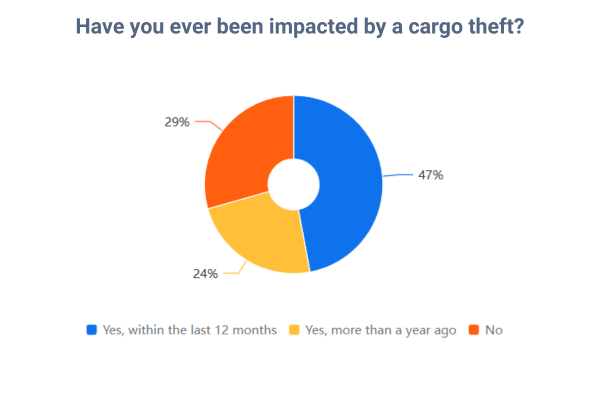
When asked whether their organization had experienced cargo theft:
That means 71% of respondents had experienced cargo theft at some point, while nearly half had experienced it within the previous year.
For this audience, cargo theft isn't a hypothetical security concern. It is something many organizations have already dealt with.
That raises a critical question for transportation security teams: Can trucking surveillance do more than document a theft after it happens?
.png)
One of the most revealing survey questions asked respondents to describe the cameras at their yards.
The finding is significant because it challenges the assumption that the answer to cargo theft is simply more cameras. Most of this audience already has video surveillance. The difference is how that video is being used.
A conventional camera can capture an unauthorized person entering a yard at 2 a.m. But if nobody sees the footage until the next morning, the camera has primarily served as a recording and investigative tool.
Real-time monitoring improves the situation because someone can potentially see suspicious activity as it happens. AI-powered video analytics introduces another layer: the ability to analyze video continuously and identify specific events that warrant human attention.
That can transform a camera from something that simply records what happened into a system that helps identify what is happening now.
This is where AI becomes particularly relevant to cargo theft prevention.
AI-powered video surveillance can be trained to recognize specific conditions or activities within a defined environment. For a truck yard, examples can include:
The important distinction is that AI doesn't have to replace the human security professional.
Instead, AI can continuously analyze the video and surface potentially significant events, allowing a human operator to determine what is actually happening and what response is appropriate.
Camera → AI detection → Alert → Human verification → Response
Rather than: Camera → Recording → Incident → Investigation
.png)
We also asked: “What's the biggest thing standing between you and better yard security?”
The most common answer was corporate approval, selected by 35% of respondents.
The responses suggest that improving cargo-theft prevention isn't purely a technology problem. Even when a security team recognizes a vulnerability, implementing a solution may require approval from corporate leadership, IT, procurement, finance, risk management or other stakeholders.
Budget was the second-most common barrier, with nearly one-quarter of respondents selecting it.
That makes the economics of existing infrastructure particularly relevant. A conventional approach to improving yard security can involve adding cameras, replacing recording infrastructure, installing new equipment and expanding monitoring capabilities.
But an alternative approach is to ask: Can existing cameras become more intelligent?
For transportation companies that already have significant camera infrastructure, AI-powered video analytics may provide a way to add intelligence without automatically requiring a complete rip-and-replace of the existing surveillance system.
Nearly one in five respondents—18%—said they weren't sure what to buy or who to trust.
When evaluating AI for cargo theft prevention, organizations need to ask practical questions:
Twelve percent of respondents selected: “We haven't had a loss serious enough to act.”
That answer highlights one of the most difficult aspects of security investment. Organizations frequently have to justify spending before a major incident occurs.
But cargo theft is inherently reactive if security improvements only happen after a significant loss.
The survey therefore raises a broader risk-management question: Should cargo-theft prevention be driven primarily by historical losses, or by the potential consequences of the next one?
Taken together, the responses point to a larger pattern.
Cameras are already widespread among this audience. The challenge is making those cameras more useful.
The progression looks something like this:
Each step changes what a surveillance system can potentially accomplish.
A recording can help investigate a theft. A monitored camera can help someone see a theft while it is occurring. AI-assisted surveillance can potentially identify a predefined threat and bring it to a human's attention without requiring someone to watch every camera continuously.
That doesn't mean AI eliminates cargo theft. It means AI can potentially shorten the distance between an event occurring and a person knowing about it.
The audience survey doesn't establish what the entire transportation industry thinks. Seventeen respondents is too small a sample for that.
But it does reveal something useful about this particular group of transportation professionals: The camera infrastructure is often already there.
The bigger opportunity may be turning passive video into active intelligence.
For trucking companies, logistics operators and transportation security teams evaluating their next investment, that leads to a different question:
Before buying more cameras, what could you do with the cameras you already have?
That is where AI-powered trucking surveillance deserves a closer look.
.png)
What happens when AI-powered video surveillance, human monitoring and real-time response are applied to one of transportation's most persistent security problems?





.svg)
.svg)

.webp)

.webp)