.webp)
.webp)
What a Trailer Works Around
Most sites renting a mobile surveillance trailer already have the one thing a trailer is built to work around: grid power. Here's what switching to a powered enclosure costs — and saves.
A real deployment across 19 locations for an Open Air Shopping Center Property Management company illustrates the point in practice: switching from leased LVT trailers to Cloudastructure powered enclosures cut monthly costs by 35% and paid for itself in under two months.
Trailers solve a real problem — sites with no power, no infrastructure. But most retail, multifamily, logistics, and data center properties already have both. Paying a mobility premium you don't need means inheriting every weakness below — all of which a fixed, powered enclosure simply doesn't have:
| Mobile Trailer | Cloudastructure Enclosure | |
|---|---|---|
| Cost | ✗$1,200–$3,000/mo + mandatory subscriptions | ✓~$1,300/mo, no subscription lock-in |
| Theft | ✗Towed away whole, in under 2 minutes | ✓Fixed to site — nothing to hitch |
| Vandalism | ✗Camera sits low, within easy reach | ✓Elevated pole, out of reach |
| Power | ✗Solar-dependent, 2–7 day battery reserve | ✓Hardwired — runs 24/7/365 |
| Integration | ✗Standalone box, disconnected from your stack | ✓Unified with AI + remote guarding |
| Collision | ✗Sits in drive lanes, no engineered setback | ✓Mounted above vehicle contact height |
| Parking | ✗Occupies a stall for the full lease term | ✓Zero stalls lost — pole or wall mounted |
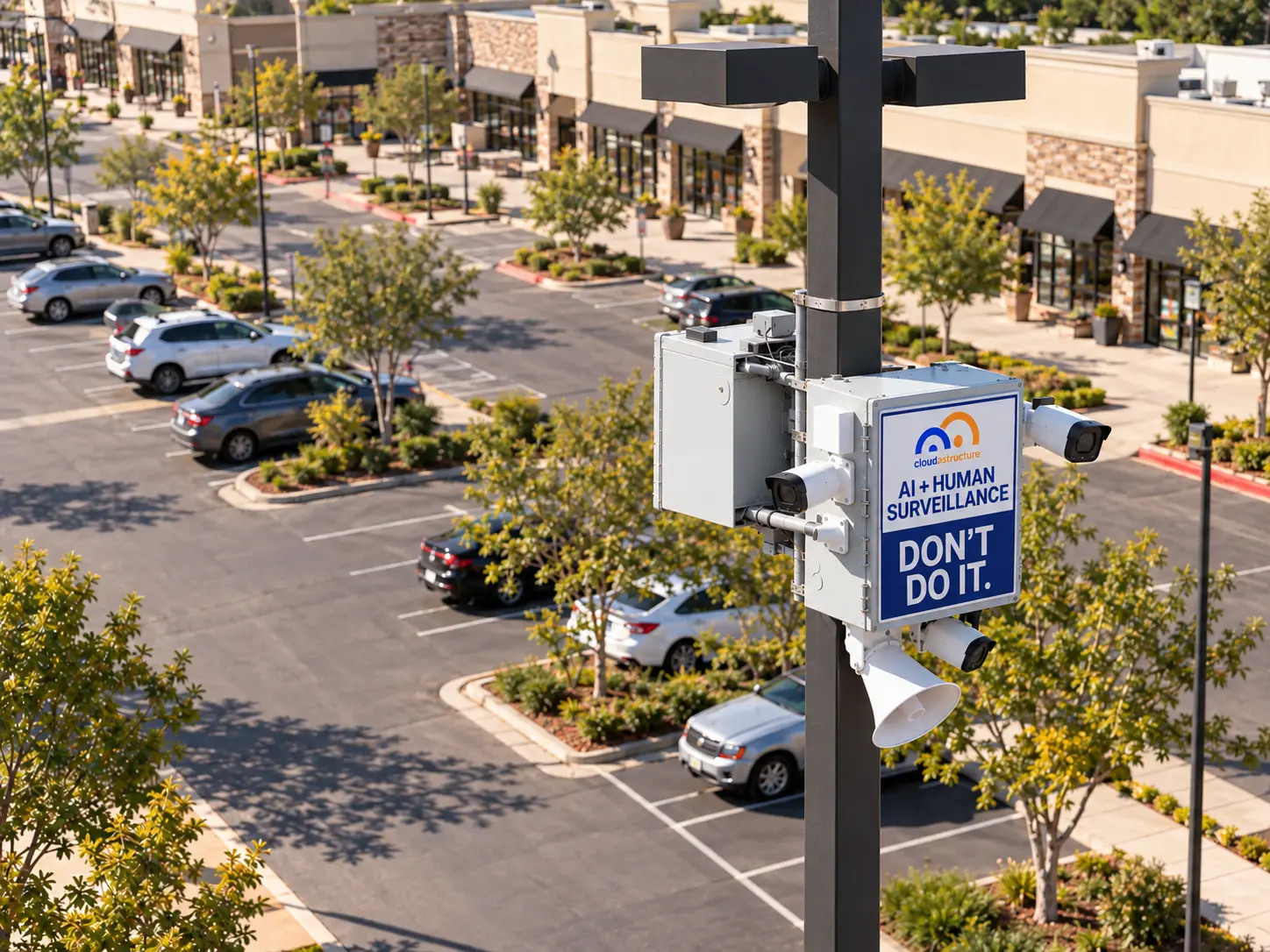
Images shown are for reference only.
An Open Air Shopping Center Property Management company operated leased LVT mobile surveillance trailers across 19 retail locations at a combined $38,000/month — $456,000 a year. Cloudastructure is replacing the fleet with powered enclosures leveraging each site's existing electrical infrastructure, at an all-in monthly cost of $24,700 — with a one-time install and shipping cost of $24,130 across all 19 sites.
This holds well beyond retail: any property with existing power — multifamily, logistics yards, distribution centers — is very likely paying a mobility premium for a problem it doesn't have.
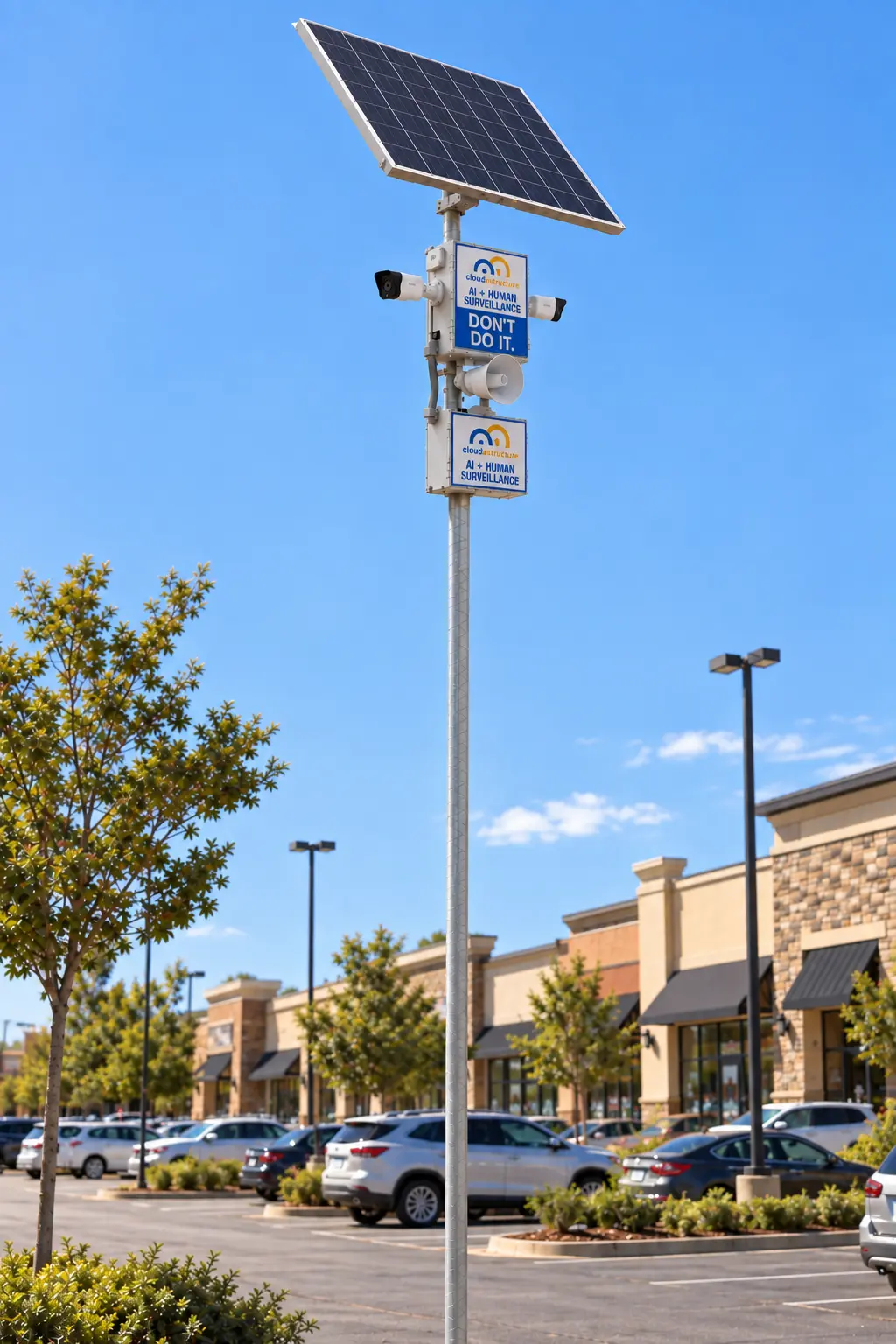
A Cloudastructure Powered Enclosure is a self-contained, weatherproof surveillance and edge-compute unit that mounts to a pole, wall, or standalone structure and ties into a site's existing electrical service — no trenching, no new conduit runs. The same hardware and software stack underpins every trade-off in the comparison above:
Each of these design choices maps directly to a line in the comparison above.
If your portfolio includes other sites, you can bring them onto that same dashboard too — one unified view with seamless remote guarding across everything you run.
.webp)
.webp)
A trailer raises its camera on a mast, but the chassis, the battery bank, the solar array and the service panel all stay at ground level, inside a parking stall, reachable by anyone who walks up to it.
Between April 2025 and September 2026, an independent tracker documented more than 128 incidents of surveillance cameras being sawed from poles, painted over, shot, set on fire, and struck with vehicles across 35 states — most of them automated license plate readers on public roadways, but not all.
Gold outline = at least one incident on privately owned equipment (retailer, HOA or developer).
The useful question isn't who's being targeted, or why. It's whether your equipment is reachable.
You own your footage — and it's in the contract
You own your video. We don't sell it, pool it into a shared network, or hand it to anyone outside Cloudastructure. It's used to run your service and improve our detection models, and it's never used publicly — a case study, a marketing clip, a reference — without your permission. That's a term in the service level agreement, not a line on a policy page.
We've never recommended auto-sharing with law enforcement
We've never recommended it, and we don't offer it as a default. A private system that routes footage to police without a warrant, a subpoena, or the owner's decision in the loop raises a Fourth Amendment question a vendor shouldn't answer on a customer's behalf. When law enforcement needs footage, the owner decides, case by case. That judgment belongs to the property, not the platform.
The record survives the attempt
A unit that stores video locally has one point of failure: itself. Cloudastructure is cloud-native — video moves off the device continuously, so an attempt on the enclosure is itself a recorded event, whether or not the hardware survives. And because remote guarding runs on the same feed, whoever's approaching can be addressed live on two-way audio while it's happening.
Trailers solve a genuine gap — sites with no power or infrastructure. Most properties evaluating one already have exactly what a trailer works around: grid power, and often an existing camera system.
A powered enclosure turns that around: lower cost, higher uptime, and stronger deterrence, with a payback period measured in weeks, not years, and savings that compound every year after.








.svg)
.svg)


