

Blog

AI-powered video surveillance and remote guarding services are fundamentally changing what's possible in multifamily security — moving from reactive recording to proactive, real-time defense. Here's how.
KEY STATS
The multifamily residential security industry is at an inflection point. Traditional approaches — on-site guards, passive cameras, after-the-fact incident reports — were built for a world where deterrence happened through physical presence. In other words, on-premises security guards. But physical presence is expensive, inconsistent, and limited by human attention.
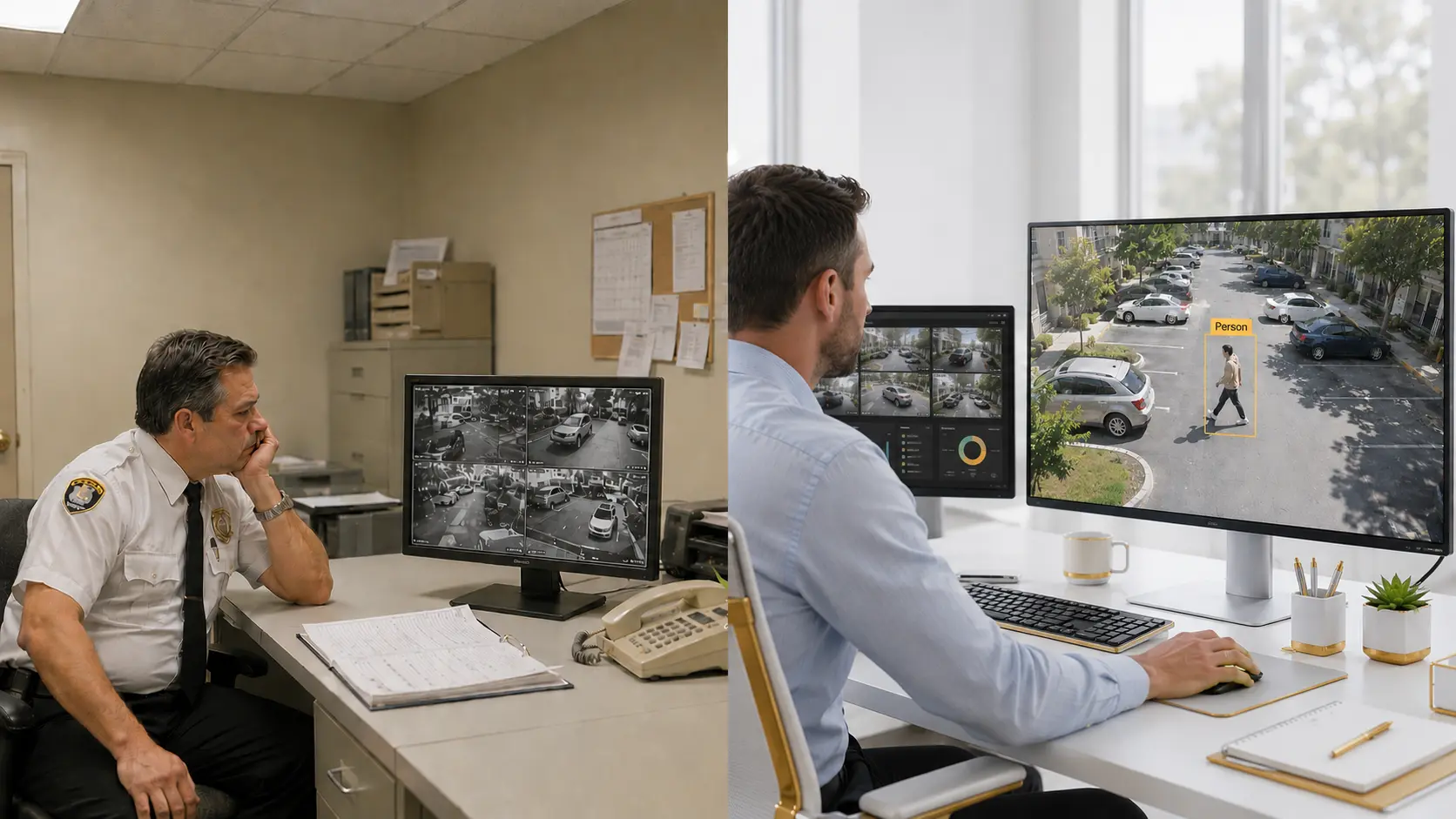
AI surveillance changes the equation entirely. Machine learning doesn't blink, doesn't take breaks, and can monitor dozens of camera feeds simultaneously — flagging anomalies in real time and triggering an immediate live response. Combined with professional remote guarding services, this creates a security posture that's simultaneously more effective and more economical than legacy approaches.
Here are the seven ways AI is transforming residential security for multifamily property owners and managers.
Traditional security analytics were retrospective: cameras recorded events, and someone reviewed footage after the fact. AI video surveillance inverts this entirely. Machine learning models are trained to recognize anomalous behavior — loitering in restricted areas, tailgating through secured entryways, individuals approaching vehicles at unusual hours — and generate instant alerts the moment those patterns are detected.
For multifamily properties, this means suspicious activity in parking structures, package theft in mail rooms, and unauthorized access to amenity spaces can be flagged in seconds — not discovered the morning after in a police report. The shift from forensic tool to proactive defense is the foundational change AI brings to residential security.
Large multifamily properties present a monitoring challenge that on-site guards simply cannot solve: too many access points, too much square footage, too few eyes. A guard can watch one area at a time. Real time surveillance powered by AI can monitor every camera on the property simultaneously — parking decks, entrances, common areas, rooftops, mail rooms, package lockers — without any of the attention fatigue that affects human operators.
Cloudastructure's AI surveillance platform processes 100% of all live footage continuously, building a dynamic picture of normal property activity. When something deviates from that baseline — an unrecognized vehicle idling in the loading zone at 2 AM, a group gathering in a restricted corridor — the system flags it immediately and routes the alert to a live operator.
“Cloudastructure has improved overall security and resident satisfaction in my apartment building. The real-time monitoring feature allows issues to be addressed as they occur.” — Krystopher P., G2 Verified Review
Remote guarding is the operational model that makes AI surveillance actionable. When the AI detects a threat, it doesn't just log an alert — it triggers a live operator who reviews the situation in real time and responds through on-site speakers. Critically, that voice belongs to a real, live agent — not a recording. This is a meaningful distinction from many competitors who use automated audio responses. A live agent can read the situation, choose the right words, and de-escalate appropriately.
That human judgment is especially important in multifamily environments, where residents and guests are moving through common areas at all hours. A live agent can instantly distinguish between a resident coming home late and an unauthorized individual who doesn't belong — and respond accordingly. An automated recording cannot. Getting this wrong doesn't just fail to stop a threat; it risks alarming or alienating the people who live there.
Cloudastructure is the only provider that combines a fully integrated Video Management System (VMS), AI-powered analytics, remote guarding software, and remote guarding services in a single seamless platform. This end-to-end architecture — from detection to live human response — is what delivers a 98% crime deterrence rate and an average threat response time of seconds.
Remote video guarding is particularly effective for multifamily properties because it provides 24/7 professional security coverage across the entire property without the cost, scheduling, and liability of maintaining a large on-site guard force.
AI-powered video surveillance extends far beyond perimeter monitoring. Modern platforms integrate directly with access control systems to add an intelligent layer of verification at every entry point. For multifamily properties, this translates into real, operational capabilities:
These capabilities operate continuously through the AI layer — no human review required until an alert is generated.
One of the most immediately compelling arguments for AI-based remote monitoring is the financial one — and it works on two fronts. First, properties that deploy remote guarding security solutions typically reduce on-premise guard costs by up to 40% annually. Second, a 98% deterrence rate on theft and vandalism means the losses that used to quietly erode NOI — stolen property, vandalism repairs, insurance claims — drop dramatically. The savings show up on both sides of the ledger.
The math is straightforward: a single AI surveillance platform with live monitoring and remote operator response covers an entire property 24/7. Guard shifts, overtime, training, turnover, and workers' compensation costs are dramatically reduced or eliminated for the coverage that the AI handles.
One Cloudastructure customer not only reduced theft losses but saved enough on guard costs that even after installation they came out 43% ahead in year one — and are projecting a 133% return on investment in year two. Because Cloudastructure works with existing camera infrastructure — no rip-and-replace — the cost basis is lower from day one.
“Cloudastructure saves us money by eliminating the need for a standing guard. With cameras, speakers, and microphones, it effectively monitors suspicious activity at our multifamily properties.”— G2 Verified Review, Multifamily Property Manager
For multifamily operators managing multiple properties, AI surveillance delivers a capability that traditional security simply cannot: centralized visibility across an entire portfolio from a single cloud-based dashboard, accessible on any device, from anywhere in the world.
Cloudastructure's platform features a tiered permission structure that gives corporate security teams, regional managers, property managers, and on-site staff each precisely the access level they need. A regional VP can review incidents across ten properties on a phone from anywhere. A property manager can pull court-ready footage for a police report in seconds. A corporate security director can monitor live feeds from any location on a laptop.
The cloud architecture also eliminates on-premise servers, DVRs, and the IT overhead that comes with maintaining local recording infrastructure. Storage is cloud-based, with 30 days of HD footage retention and playlists stored up to one year — all watermarked and court-ready.
Unlike static security systems, AI-powered video surveillance improves with time. Surveillance data from your specific property — the traffic patterns, the normal ingress/egress rhythms, the seasonal variations in activity — is annotated and fed back into the AI model, continuously refining its ability to distinguish genuine threats from normal activity at your location.
This means false-alert rates decrease over time as the system learns your property's baseline. Detection accuracy improves. And the AI becomes genuinely attuned to what "normal" looks like for your specific community — making anomaly detection sharper with every passing week.
For multifamily operators, this continuous improvement loop means a security system that is not just deployed and left static, but actively evolving to meet the specific threat profile of each property in the portfolio.
The era of reactive security — cameras that record incidents rather than prevent them — is over. AI surveillance and remote guarding services represent a fundamental shift in what's possible: proactive, 24/7, real-time defense that gets smarter over time, costs less than traditional guard-heavy models, and gives multifamily operators complete visibility across their entire portfolio from a single platform.
For property managers and owners who are still relying primarily on on-site guards and passive cameras, the question is no longer whether AI-powered security makes sense. It's how quickly the transition can be made.
What is AI surveillance for multifamily properties?
AI surveillance uses machine learning and computer vision to monitor security cameras in real time, automatically detecting suspicious activity, unauthorized access, or threats — and alerting operators before an incident escalates. Unlike traditional cameras that simply record, AI surveillance is proactive.
How does remote guarding work?
Remote guarding pairs AI-powered video surveillance with live monitoring operators who can intervene in real time — speaking directly to individuals on-site through speakers, notifying law enforcement, and documenting incidents. At Cloudastructure, that voice is always a real, live agent — not an automated recording. This allows operators to distinguish residents from trespassers and respond with appropriate judgment. Remote guarding replaces or supplements on-site guards at a fraction of the cost, while achieving higher deterrence rates.
Can AI video surveillance reduce security costs for apartment complexes?
Yes. Properties using AI-powered video surveillance and remote guarding services typically reduce on-premise guard costs by up to 40% annually. Additionally, a 98% deterrence rate on theft and vandalism reduces losses that erode NOI. One Cloudastructure customer saved 43% in year one including installation costs and is projecting a 133% ROI in year two.
What is the deterrence rate for AI-powered security systems?
Cloudastructure's AI surveillance platform achieves a 98% crime deterrence rate across monitored properties, with an average threat response time of seconds.
Does AI surveillance work with existing security cameras?
Yes. Cloudastructure's AI-powered surveillance platform is camera-agnostic and integrates with virtually all existing camera types — no rip-and-replace required. Both fixed and mobile surveillance solutions are available for properties with infrastructure or bandwidth limitations.
Schedule a free demo and see how Cloudastructure protects your properties in real time — before incidents happen, not after.





.svg)
.svg)

.webp)

