

Blog

Retail shrink costs U.S. retailers nearly 2% of sales annually — and organized retail crime is accelerating. This buyer's guide breaks down the five criteria that separate effective AI security systems from expensive cameras that just record what you've already lost.
The retail security industry is in the middle of a significant transition. Traditional loss prevention models — floor walkers, static cameras, exception-based reporting — were designed for a threat environment that no longer exists. Organized retail crime has become more sophisticated, shrink is rising, and LP staffing is expensive, inconsistent, and hard to scale across multi-location operations.
AI-powered video surveillance and remote guarding services have emerged as the most compelling answer — but not all platforms are created equal. This guide covers the five criteria that matter most when evaluating AI security systems for retail loss prevention, and what the benchmarks should be.
The most important distinction in retail AI surveillance is not feature count — it's whether the system stops crime or just documents it. Most traditional camera systems, and even some platforms marketed as "AI-powered," are fundamentally passive: they record everything and surface relevant footage after an incident. That's useful for prosecution. It does nothing to prevent the loss.
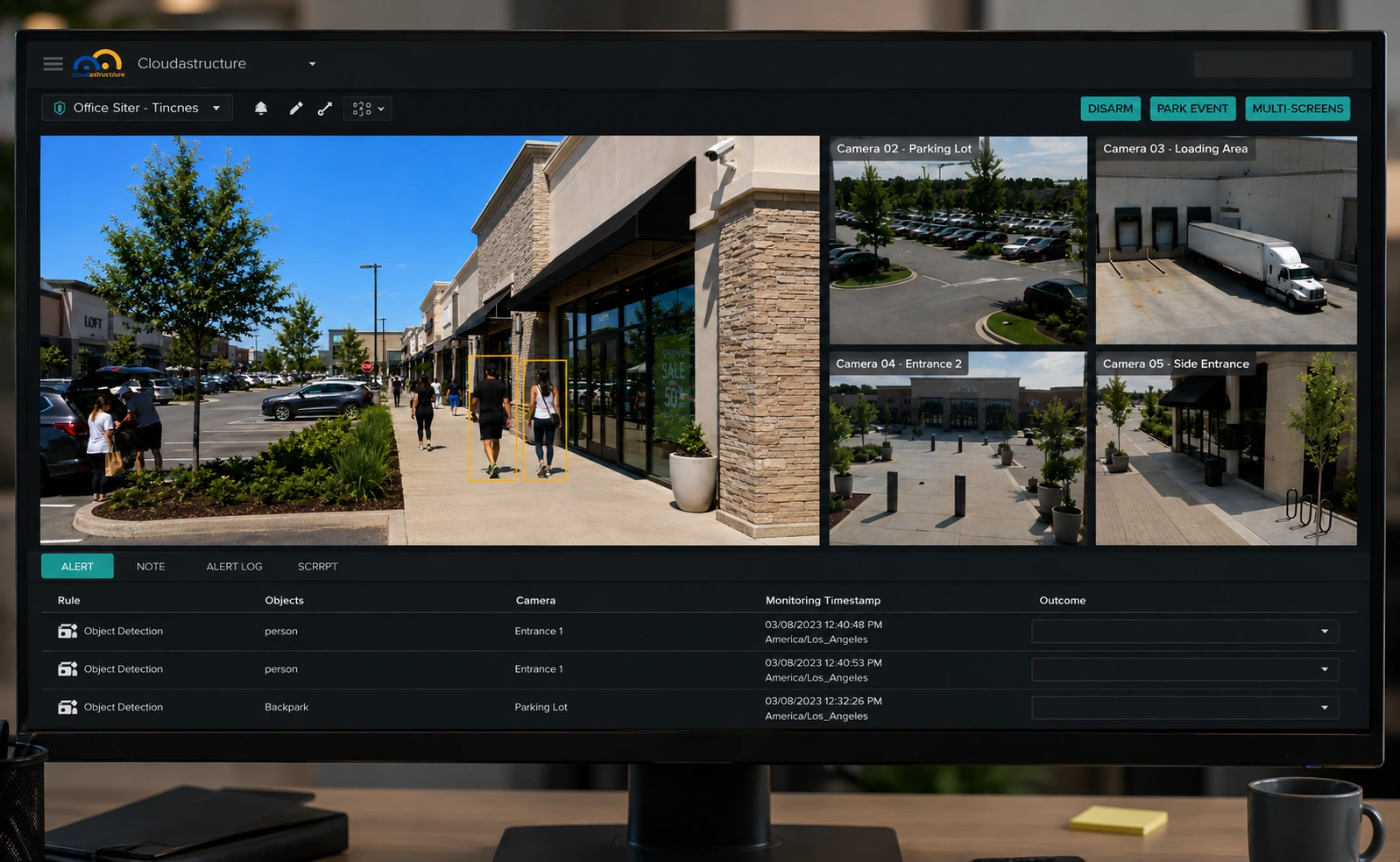
But here's what most retail security vendors get wrong about active deterrence: it doesn't belong inside the store. Voice-down intervention on a crowded sales floor doesn't stop shoplifters — it startles paying customers and creates a negative experience that drives them out the door. The real value of real time surveillance and live intervention is in the spaces around the retail complex: parking lots, entryways, loading areas, and common thoroughfares.
These are the environments where AI-powered video surveillance delivers its highest ROI. A live operator can intervene when an altercation breaks out in the parking lot before it escalates inside. Suspicious individuals loitering near entrances can be addressed before they enter. And critically, the AI can flag and mark known shoplifters as bad actors — so the moment they return to the property, staff are alerted before they ever reach the sales floor. That's proactive loss prevention, not reactive footage retrieval.
False alarms are the silent killer of AI security ROI in retail. A system that generates dozens of false alerts per shift doesn't just waste operator time — it trains the entire security operation to ignore alerts. Alert fatigue is real, and it's the reason even well-funded LP departments end up with camera walls nobody watches.
The false alarm rate is the single most important performance metric to request from any AI security vendor. Effective AI video surveillance platforms should target false alarm rates below 5%. The best platforms operating in well-tuned retail environments achieve rates below 1%.
A low false alarm rate is not a default — it's the result of machine learning models trained specifically on retail environments, combined with continuous feedback loops that refine the model based on confirmed and dismissed alerts at your specific locations. When evaluating vendors, ask for their documented false alarm rate across retail deployments — not a general figure, but retail-specific performance data.
Use this framework when evaluating any AI-powered video surveillance platform for retail loss prevention:
For multi-location retailers, one of the most significant cost variables in any AI security deployment is whether the platform requires proprietary hardware. Vendors who require a full camera replacement add capital expense and lock you into their ecosystem indefinitely.
The strongest platforms are camera-agnostic: they work with virtually any existing camera infrastructure, regardless of brand or age. For retailers with legacy camera systems across dozens of locations, this is the difference between a deployment that takes weeks versus one that requires a multi-year capital program.
Cloudastructure's camera-agnostic platform integrates with existing systems across all major camera types, with both fixed and mobile surveillance solutions available for locations with infrastructure or bandwidth limitations. No proprietary hardware. No long-term contracts. Month-to-month pricing.
When calculating total cost of ownership, account for: hardware, installation, software licensing, monitoring fees, and guard cost offsets. A platform that costs more per month but eliminates significant LP staffing costs across your locations is not an expense — it's a financial reallocation.
Remote guarding services represent the most significant financial lever available to retail loss prevention directors today. AI continuously monitors the environment and only escalates to a live operator when something genuinely requires human judgment.
That live operator — watching a real-time feed, not a recording — can intervene through on-site speakers in the appropriate areas, coordinate with store staff, and contact law enforcement as appropriate. Critically, this is a real, live agent making judgment calls in the moment, not an automated audio recording.
Remote video guarding is not a replacement for all LP functions — investigations, employee training, and exception-based analytics still benefit from dedicated LP professionals. But for the monitoring and real-time deterrence functions that consume the majority of LP staff hours, remote guarding security delivers equivalent or superior outcomes at a fraction of the cost. Customers typically reduce on-premise guard and LP monitoring costs by up to 40% annually.
The deterrence effect is significant: a 98% crime deterrence rate — the benchmark Cloudastructure achieves across monitored retail and commercial locations — means the vast majority of would-be incidents never materialize. When evaluating any platform, ask for their documented deterrence rate across retail deployments.
The best security analytics platforms don't just generate alerts — they build an operational intelligence layer that improves over time. Surveillance data is annotated, confirmed alerts and dismissed false positives are fed back into the AI model, and detection accuracy improves continuously for your specific locations.
For retail operators, this means the system becomes more attuned to your specific environment with every passing week. Demand to see how vendors handle model improvement: is it a manual process requiring vendor involvement, or is it automated and continuous?
✓ Documented false alarm rate below 5% in retail environments (best-in-class: below 1%)
✓ Live human operator intervention — not automated audio responses
✓ Camera-agnostic compatibility — works with your existing infrastructure
✓ Average threat response time of seconds, not minutes
✓ No proprietary hardware requirements
✓ Fixed and mobile deployment options for varied location types
✓ Cloud-based platform with multi-location dashboard and tiered permissions
✓ Court-ready footage with 30-day cloud storage minimum
✓ Month-to-month pricing with no long-term contracts
✓ Documented deterrence rate across retail or commercial deployments
✓ Fully integrated remote guarding software — no third-party middleware like Immix required, no separate reporting tools like Calypso, no additional licensing costs or extra logins slowing down response time
The best AI security system for retail loss prevention is not the one with the longest feature list — it's the one that stops crime before it happens, generates the fewest false alarms, works with your existing camera infrastructure, and delivers a cost model that funds itself through guard cost offsets and reduced shrink.
When evaluated against those criteria, the benchmark is clear: a false alarm rate below 1%, a documented crime deterrence rate of 98%, live agent intervention in seconds, camera-agnostic compatibility, fully integrated remote guarding software with no third-party add-ons, and month-to-month pricing with no proprietary hardware. Any platform you evaluate should be measured against those numbers.
What is the best AI security system for retail loss prevention?
The best AI security system for retail loss prevention combines real-time threat detection, a false alarm rate below 1%, camera-agnostic compatibility, active deterrence via live remote guarding, fully integrated software with no third-party middleware, and cloud-based management across all locations. Cloudastructure achieves a 98% crime deterrence rate and a false alarm rate of less than 1%, making it a leading benchmark in the category.
How does AI reduce false alarms in retail security?
AI security systems learn the normal activity patterns of a specific retail environment — distinguishing between shoppers browsing and genuinely suspicious behavior. Over time, the system's false alarm rate decreases as the model is continuously tuned to the specific location. Cloudastructure's false alarm rate is less than 1% across monitored retail deployments.
Can AI remote guarding replace loss prevention staff?
AI remote guarding can replace or substantially supplement on-site loss prevention staff for monitoring and deterrence functions. Live remote operators — real people, not automated recordings — watch AI-flagged alerts in real time and intervene through on-site speakers in appropriate areas such as parking lots, entryways, and common thoroughfares. Customers typically reduce on-premise guard costs by up to 40% annually.
What should I look for in a retail AI security system?
The five most important evaluation criteria are: (1) false alarm rate — aim for under 1%; (2) active deterrence via live agents in the right locations — parking lots, perimeters, and entryways, not crowded sales floors; (3) camera compatibility — will it work with your existing infrastructure?; (4) total cost of ownership; (5) fully integrated remote guarding software — no third-party middleware like Immix or separate reporting tools like Calypso that add licensing costs and delay response times.
How much does AI retail security cost?
Cloudastructure offers subscription-based pricing at $349 per camera per year for AI surveillance, with remote guarding services available separately. There are no long-term contracts and no proprietary hardware requirements — the platform works with existing cameras, significantly reducing total cost of ownership. Most customers offset the cost through guard cost reductions within the first year.
Get a live walkthrough of Cloudastructure's AI surveillance and remote guarding platform. We'll show you real detection examples, false alarm rates, and a cost comparison against your current security model — no commitment required.





.svg)
.svg)


.webp)
.webp)