.webp)
.webp)
Florida's 2023 tort reform legislation changed the rules for negligent security litigation — and most multifamily property owners still don't fully understand what it requires, what it protects, or what it could cost them if they ignore it.
This guide draws on expert analysis from Amanda Podlucky, one of Florida's most sought-after liability attorneys in property management, and Randy Atlas, America's only practicing architect and criminologist, a CPTED practitioner, author, and expert witness who conducts security vulnerability assessments and CPTED studies across the country. Here is what they say every multifamily owner and operator needs to know.
Before the tort reform, Florida operated under pure comparative negligence. A property owner could be 99% innocent and still face full liability if they bore even 1% of fault. The litigation environment it created was staggering:
The 2023 reforms changed three things that directly affect multifamily owners:
The presumption against negligent security is not a complete defense. It does not mean that if you comply, you cannot be sued. What it means is this: if a multifamily property owner or operator can demonstrate substantial implementation of the required security measures, the burden of proof shifts to the plaintiff to overcome that presumption.
"It's just a presumption. It's not 'here we go, we complied, game over, summary judgment in your face.' Once you establish substantial implementation, the burden shifts to the plaintiff to prove negligence in spite of that presumption. That is a very high threshold for them to clear."
Critically, the presumption protects both the property owner and the property manager — whichever entity is named in the lawsuit, or both.
Under the law, substantial implementation requires compliance across the following areas:
Surveys can only be legally conducted by someone who has completed the Florida Attorney General's CPTED course, or by a certified law enforcement professional. In practice, most police departments have stopped participating — the liability exposure discourages them. This means working with a certified private practitioner.
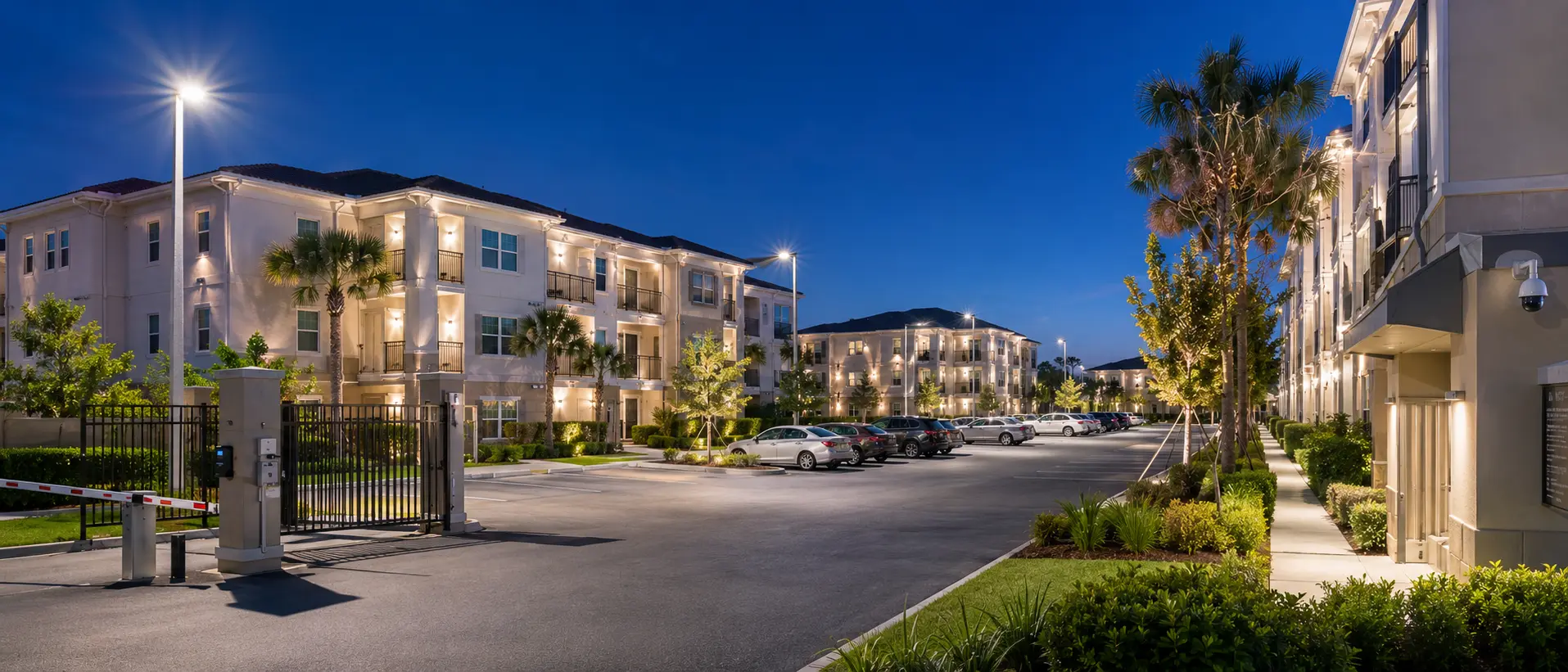
Cameras are required at points where people enter and exit the property. For a mid-rise or high-rise with a single entry, that means surveillance at that entry. For a townhouse-style development, it does not mean a camera on every individual unit door. The intent is that access points to the property — not individual apartments — must be covered.
Footage must be retained for 30 days to support law enforcement investigation and evidence collection in the event of a crime.
Parking lot lighting must meet 1.8 foot candles measured at 18 inches above the ground, and every single parking space must be measured. This is not drawn from the Illumination Engineering Society's standards — it was written into the statute independently. If your property has a parking garage, you use IES safety standards instead, which typically run 3 to 5 foot candles and allow periodic measurements.
The statute requires a minimum level of lighting but does not specify an exact measurement — deferring to Florida building code, local ordinances, and IES national standards. The IES recommends 10 foot candles for mailbox areas, roughly 5 foot candles for larger rooms, and most zoning codes require 1 foot candle for exterior sidewalks.
Every exterior door must have a one-inch throw deadbolt. What the statute does not specify is the hardware securing the lock and strike plate — that falls under the CPTED assessment. Three-inch wood screws instead of the quarter-inch screws that typically come with an off-the-shelf lockset can make the difference between a door that holds and one that doesn't.
All windows and sliding glass doors must be lockable. The statute does not require ventilation locks — the type that allows a window to open 4 inches while preventing it from being pushed further — but these are strongly recommended under CPTED best practices.
Gates must now be secured with a PIN code, key, biometric, or RFID card. The traditional 48-inch pole with a tab — standard in the Florida building code for decades — is no longer acceptable. The new standard requires active, verifiable access control.
If an exterior door has no side view panel or window, it must have a peephole at the correct height for the occupant to see who is at the door. If a window is already adjacent to the door, no peephole is required.
The survey is not a one-time certification. It must be renewed every three years as property conditions change.
Management staff must be trained on what the law requires, what CPTED is, and what the property's specific survey findings are. This is not optional, and it is not limited to senior management. Training is approximately 90 minutes to two hours and results in a certificate that becomes part of the compliance record.
The hardware and lighting items above are one component of substantial implementation. The CPTED assessment covers what Randy Atlas describes as "the global, bigger picture" — everything the statute doesn't enumerate but still matters in a negligent security claim:
- Signage and wayfinding
- Landscaping and planting that doesn't create concealment
- Graffiti, tagging, and property maintenance
- Trespassing and loitering management
- Tenant screening practices
- Door maintenance — not just having a deadbolt, but ensuring the hardware is properly secured
- Whether management practices are creating or reducing crime opportunity
"The CPTED part looks at the bigger picture. Are you having good management practices? Are you screening tenants? Is door maintenance proper?"
Amanda Podlucky is direct about how courts are likely to apply this standard:
"It's kind of a numerical compliance as well as substantive compliance based on each specific claim. If you had a drowning related to the pool, that one element — access control to the pool — would probably need to be the most compliant. If you hit eight out of nine items but didn't have the one that really mattered, it probably wouldn't be considered substantial implementation."
The practical implication: aim for full compliance across all items, not a threshold number. The statute offers no safe harbor at 80%. Compliance is judged both by the number of items checked off and by whether the specific item most relevant to the incident was in place.
Do Assessments Need to Cover Every Unit?
Technically, the statute implies yes. Practically, Randy Atlas's approach is more workable — but it comes with teeth. His firm sends management and maintenance staff a survey form requiring them to physically check every unit and attest in writing to compliance. During the site visit, he conducts a random sample — at least one unit per building, or one per floor.
"If I find doors that are not properly secured and the peephole has been painted over and the deadbolt screws are loose — I read the riot act to management. Because you've just signed a legal document attesting that they're all in compliance. The one apartment where there's not a window lock, and that's the one where a child falls — you're going to be liable."
Who Needs to Be Trained, and On What?
Training requirements apply broadly. Randy Atlas recommends that every member of the on-site team take the training — not just the property manager:
- Leasing office and management staff
- Maintenance personnel
- Any on-site security guard company
"The more participation you get from people in the security process extends your eyes and ears on the property. It's free. It's available. If people take it, they get a certificate of compliance. And all of this is about leaving a paper trail."
Should Assessments Go Through Legal Counsel?
Both experts agree that routing the CPTED assessment through the property's legal counsel is generally preferred, though Amanda Podlucky clarifies it is unlikely to change discoverability once a lawsuit is filed:
"Once the lawsuit is filed, these are generally going to become discoverable anyway. If it's favorable and something we're going to want to use to establish that presumption, it's something we'll want to turn over."
The value of going through counsel is in the buffer it provides before litigation begins — and in giving attorneys early visibility into any compliance gaps that need to be addressed.
What About Trespassers?
The law creates an important distinction based on who was on the property and why. For lawful invitees — residents, guests, delivery personnel — the full presumption framework applies. For trespassers, the duty of care is lower and there is often an immunity from liability.
"If you can determine through camera footage that they're not supposed to be there or they didn't lawfully gain access to the premises, then you have a defense right out of the gate that you might not realize otherwise. That's exactly why active monitoring and documentation really matters."
Both experts are unequivocal: yes.
"If you're feeling lucky and want to assume the risk — don't do your survey. Don't fix the lighting. Don't screen tenants properly. And when you get hit with a lawsuit, you are naked before the judge."
"You're never going to be punished in a lawsuit for having too much compliance or too much security. It can only harm you if you don't comply. This presumption just raises the bar so high that it's going to be very difficult for plaintiffs to get over that hurdle."
For older properties that worry about feasibility: Randy Atlas estimates that 75 to 80% of CPTED recommendations on any given property are low-hanging fruit — maintenance fixes, paint, additional lighting, ensuring gates close, making sure hardware is correct. The one high-cost item is typically parking lot lighting, and even that carries a return on investment of two to three years through energy savings.

The presumption against negligent security is real, meaningful, and currently underused. The path to substantial implementation:
The properties doing this work are creating a paper trail that can, in Amanda Podlucky's words, "shift the burden back to the claimant and get a case out of the hands of a jury entirely." The ones that aren't are hoping they never need it.
.webp)
One of Florida's most sought-after liability attorneys in property management, with a client list that includes Greystar, RPM Living, and many of the state's largest operators. Amanda's practice covers the full range of property management liability, including negligent security claims arising from Florida's evolving tort reform landscape.
.png)
America's only practicing architect and criminologist, a leading Florida CPTED practitioner, author, and expert witness. Randy conducts risk assessments, security vulnerability assessments, and CPTED studies for public and private sector clients, and is CAPB-class certified in the International CPTED Association.
This white paper is drawn from Cloudastructure's webinar Florida's Civil Remedies: Is It a Carrot or a Stick?, featuring Amanda Podlucky and Randy Atlas. To hear the full conversation — including live Q&A — watch the recording below.
.webp)
Florida's Civil Remedies: Is It a Carrot or a Stick?
Featuring Amanda Podlucky and Randy Atlas, with live Q&A.
Cloudastructure provides AI-powered remote guarding built for multifamily, commercial, and enterprise properties — stopping crime before it happens through intelligent monitoring and real-time intervention.
Learn more at cloudastructure.com
This white paper reflects expert opinion expressed in a publicly available webinar and does not constitute legal advice. Consult qualified legal counsel for guidance specific to your property.








.svg)
.svg)


